Table of Contents
- What Is an ARC Reader and Why Your Book Launch Needs One
- Where to Find ARC Readers for Free: Communities, Bloggers, and Bookstagrammers
- Best Platforms for Finding ARC Readers: A Practical Comparison
- How Long Before Release Should I Send ARCs?
- ARC Review Request Email Templates That Get Yes Replies
- How to Manage an ARC Team Without Losing Your Mind
- How to Vet and Verify ARC Readers Before You Send a Single Copy
- Frequently Asked Questions
Last Updated: September 28, 2026
What Is an ARC Reader and Why Your Book Launch Needs One
An ARC reader is someone who receives an advance reader copy of your book before launch day, reads it early, and posts an honest review when the book goes live. This guide from ReaderReach breaks down exactly how to find ARC readers for beginners, step by step.
Here's why this matters so much. Most book launches live or die on early reviews. A book with ten honest reviews on day one looks alive to shoppers. A book with zero reviews looks invisible, no matter how good it is.
ARC readers solve that problem. They also give you something else: real feedback before the wider world sees your book.
Many authors treat ARCs as a one-time launch chore. That's a mistake. A good ARC team becomes your review team for every future release. Build it once, keep it warm, and you never start from zero again.
Where to Find ARC Readers for Free: Communities, Bloggers, and Bookstagrammers
Free ARC readers are everywhere once you know where to look. The trick is matching your genre to the right community.
Start with these spots:
- Book bloggers who review your genre and accept indie submissions
- Bookstagrammers and BookTokers who post reviews with a small but loyal following
- Goodreads groups built around your category
- Genre-specific Facebook groups for readers and authors
- LibraryThing and similar reader communities
- Your own mailing list, if you have one
The book community runs on relationships. A blogger with 500 true fans beats an account with 50,000 passive followers every time.
Reach out personally. Skip the copy-paste blast. Mention a specific book of theirs you liked, then ask if they'd consider your title.
Alliance of Independent Authors guidance on reviews and reader outreach
Best Platforms for Finding ARC Readers: A Practical Comparison
The best platform depends on your genre, your budget, and how much time you can give. Here's a closer look at the main options, including what each one actually asks of you.
| Platform Type | Best For | Cost | Effort Level |
|---|---|---|---|
| StoryOrigin | Cross-promos and swaps | Free tier | Medium |
| BookSirens | Genre-matched readers | Pay per reader | Low |
| NetGalley | Library and trade reach | Higher fee | Low |
| Hidden Gems | Romance and fiction | Small fee | Low |
| Social media groups | Hands-on authors | Free | High |
| Managed outreach | Time-short authors | Varies | Very low |
StoryOrigin rewards authors who swap with others. You list your book, offer a review copy, and in return you agree to review someone else's. The trade-off is reciprocity: you get readers, but you also owe reads. If you're already a voracious reader in your genre, this is a great fit. If you're not, it can feel like a second job.
BookSirens and Hidden Gems hand you readers but charge per copy. You set your genre and preferences, and the platform matches you with readers who've opted in. The upside is speed and low effort. The downside is that you're renting an audience, not building one. When the campaign ends, those readers don't necessarily follow you to your next book.
NetGalley reaches librarians and booksellers, which suits some genres better than others. Literary fiction, nonfiction, and books with library appeal tend to do well there. Genre romance and thriller authors often find better ROI on reader-focused platforms. NetGalley also has a higher learning curve and a higher cost, so it's usually not the first stop for a beginner.
Social media groups are free but hands-on. You'll post in Facebook groups, reply to DMs, and personally invite readers. The upside is relationship-building. The downside is time. A single viral post can bring in fifty readers, or you can spend a week and get three. It's unpredictable.
Then there's the do-it-for-you route. ReaderReach runs genre-matched outreach to book clubs, podcasts, libraries, and reading circles on your behalf. If you'd rather write than chase replies, that's the shortcut.
A common mistake is signing up for five platforms at once.
Automated vs. Manual Workflows: Which Fits a Beginner?
This is the part most guides skip, and it's where beginners get stuck. You have two basic ways to run your ARC campaign: manual or automated.
How Long Before Release Should I Send ARCs?
Send digital ARCs 8 to 10 weeks before release. That window gives readers enough time to finish the book and post a review without forgetting it.
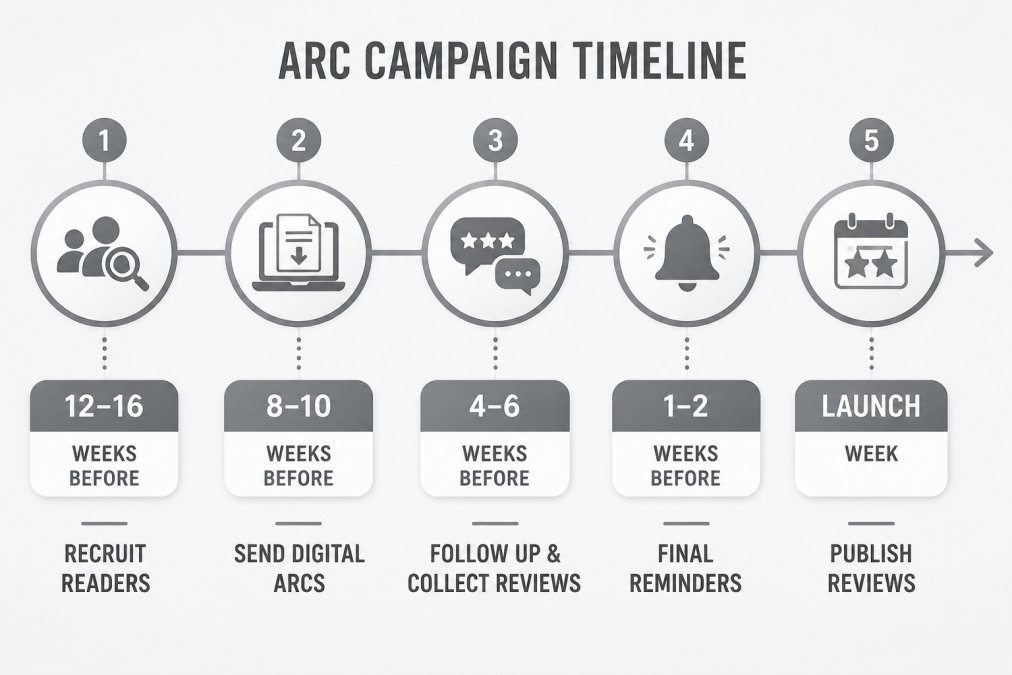
Here's a simple schedule to follow:
- 12 to 16 weeks out: Recruit your readers
- 8 to 10 weeks out: Send digital ARCs
- 4 to 6 weeks out: Follow up and collect reviews
- 1 to 2 weeks out: Send final reminders
- Launch week: Reviews go live
ARC Review Request Email Templates That Get Yes Replies
A good ARC request email is short, personal, and easy to say yes to. Here are two templates you can copy today.
Template 1: Cold outreach to a blogger
Template 2: Follow-up after sending the ARC
How to Manage an ARC Team Without Losing Your Mind
Managing an ARC team comes down to three things: a clear list, clear rules, and gentle follow-ups. Get those right and the chaos disappears.
Set up a simple system:
- Keep a spreadsheet or CRM of every reader, their genre, and their status
- Share a short review policy up front: timeline, platforms, and disclosure
- Send one reminder, not five
- Track who reviewed and who went quiet
- Thank everyone, even the ones who passed
How to Vet and Verify ARC Readers Before You Send a Single Copy
Vetting ARC readers protects your launch and your sanity. Most guides skip this step, which is exactly why it's worth doing well. A little screening up front saves you from the silent ghosting that plagues so many first-time campaigns.
Red Flags to Watch For
- No review history at all, plus a brand-new account. Not always a scam, but worth a conversation.
- Requests for multiple formats or multiple copies. One reader, one copy.
- Pressure to guarantee a positive review. That's a hard no. Walk away.
- Requests for payment to review. Legitimate reviewers don't charge for honest reviews.
- Generic copy-paste messages. Real readers mention your book, not just "I'd love a free copy."
The Legal and Compliance Checklist Most Guides Bury
This is the part that trips up beginners, and it's the part competitors often leave in forum threads. Here's what you actually need to know.
- Readers must disclose free copies. The FTC expects reviewers to state clearly that they received a free copy in exchange for an honest review. You can point readers to the FTC endorsement guidelines so they understand the rule.
- Your review policy should state this clearly. Put it in your sign-up form or welcome email. Something like: "You'll receive a free copy. If you review, please note that you received a free copy."
- Keep records of who received what. A simple spreadsheet with names, emails, dates, and formats sent is enough. If a platform ever asks, you'll have it.
- Never require a positive review. Asking for a guaranteed five stars breaks review site rules and can get your book flagged. Ask for an honest review, and mean it.
- Check platform rules. Amazon, Goodreads, and BookBub all have their own review policies. A quick read before you launch saves headaches later.
Goodreads author guidelines on reviews and giveaways
Automated vs. Manual Vetting
Manual vetting gives you control but eats hours. Automated tools screen faster but miss nuance. For a beginner, a hybrid works best: automate the list and the initial screening, then eyeball the final send yourself. That way you catch the obvious mismatches without spending your whole weekend on spreadsheets.
Frequently Asked Questions
Where can I find ARC readers for free?
You can find ARC readers for free through book blogging communities, Bookstagram and BookTok hashtags, genre-specific Facebook groups, Goodreads groups, and your own mailing list. Start by searching for readers who already review books in your genre, then reach out with a friendly, personalized message. Building genuine relationships in these communities takes time but costs nothing beyond your effort. A simple landing page where readers can sign up for your ARC team helps you collect interest without chasing people individually.
Do ARC readers get paid?
No, ARC readers do not get paid. They receive a free advance copy of your book in exchange for an honest review. The copy itself is the compensation. Some authors offer small thank-you gifts like bookmarks or entry into a giveaway, but payment for reviews violates the review policies of most major platforms. If you want paid promotion, that is advertising, not ARC outreach. Keep your ARC team focused on readers who genuinely enjoy your genre and want early access.
How many ARC readers do I need for a successful launch?
A realistic target for a first launch is 20 to 50 committed ARC readers. Not everyone who signs up will finish the book or post a review, so plan for roughly half to follow through. If you are launching a series or have an established audience, aim for 50 to 100. Quality matters more than quantity. Ten readers who love your genre and post thoughtful reviews will do more for your launch than fifty who never open the file. Focus on genre-matched readers who are excited about your book.
What is the best way to manage an ARC team as a new author?
Start with a simple system: a sign-up form, a dedicated email list, and a shared calendar for deadlines. Send a welcome email that explains what you need (honest review, where to post, by when), then follow up at key milestones. Facebook groups or Discord servers work well for group communication. Track who has received a copy, who has posted, and who needs a nudge. If managing outreach feels overwhelming, a service like ReaderReach can handle research and follow-up so you can focus on writing.