Table of Contents
- Why Finding the Right Readers Matters for Your Science Fiction Book
- Identify Your Target Audience: Which Science Fiction Readers Want Your Story
- Finding Science Fiction Beta Readers for Early Feedback
- Connect with Science Fiction Book Reviewers and Review Bloggers
- Reach Readers Through Science Fiction Book Clubs
- Book Club Outreach for Authors: A Step-by-Step Approach
- Build Reader Community Beyond Initial Reviews
- Common Mistakes to Avoid When Finding Science Fiction Readers
- Frequently Asked Questions
Last Updated: October 18, 2026
Why Finding the Right Readers Matters for Your Science Fiction Book
Learning how to find readers for a science fiction book is one of the hardest parts of being an author.
The challenge is that science fiction readers are scattered across the internet, in book clubs, forums, reading circles, libraries, podcasts, and online communities. Without a plan, reaching them feels impossible.
But here's what we've learned: the authors who succeed aren't the ones who blast their book everywhere. They're the ones who target specific readers who match their story.
This guide walks you through exactly how to find readers for a science fiction book.
Identify Your Target Audience: Which Science Fiction Readers Want Your Story
Before you reach out to anyone, you need to know who you're looking for. Science fiction is massive, spanning everything from dystopian thrillers to soft sci-fi romance to hard technical space stories.
Know your subgenre and comparable books
Your subgenre is your anchor. It tells you which readers to target and where to find them.
Start by naming your subgenre clearly:
- Military sci-fi
- Space opera
- Cyberpunk
- Post-apocalyptic
- Time travel
- AI and robotics
- Hard sci-fi
- Soft sci-fi
Next, find comparable books, published science fiction titles that sit near yours on the shelf. They don't have to be exact matches, just share your core elements. Readers who loved those books are your ideal readers: they already like the kind of story you wrote. Write down 3-5 comparable titles with author and publication year. This becomes your targeting tool.
Understand reader preferences in your niche
Different science fiction readers want different things.
Military sci-fi readers often want:
- Tactical detail and strategy
- Team dynamics and loyalty
- High stakes and survival
- Clear good vs. bad sides
Space opera readers typically seek:
- Epic scope and world-building
- Ensemble casts and relationships
- Political intrigue and power struggles
- Sweeping storylines across books
Cyberpunk readers usually crave:
- Tech-forward settings
- Moral ambiguity and gray characters
- Corporate power and resistance
- Gritty, urban atmospheres
Post-apocalyptic readers commonly want:
- Survival challenges and resourcefulness
- Human resilience and adaptation
- Detailed world collapse logic
- Hope mixed with hardship
Knowing these preferences helps you talk to readers in their language and speak to what they actually care about, not generic book praise.
Finding Science Fiction Beta Readers for Early Feedback
Beta readers are your first real audience. They read your manuscript before publication and give honest feedback. They're not professional reviewers. They're readers who want to help and give their genuine reaction.
Where to recruit beta readers
Science fiction communities online are full of people willing to beta read. Here's where to find them:
Reddit communities like r/scifiwriting and r/betareaders have active members looking for manuscripts to read. Post clearly what you're looking for and what you expect from readers.
Critique forums like Absolute Write and Critique Circle connect writers with beta readers. Many have science fiction sections specifically.
Facebook groups dedicated to science fiction readers and writers often have beta reader requests. Search for groups focused on your subgenre.
Goodreads has reader groups and author communities. Join groups focused on your subgenre and ask for beta readers there.
Writing communities like NaNoWiMo forums and Wattpad have readers actively looking for manuscripts.
The key is finding readers who already love your subgenre. A beta reader who doesn't care about military sci-fi won't give useful feedback on a military sci-fi novel.
What to ask and how to handle feedback
When you recruit beta readers, be clear about what you need:
- How long is the manuscript?
- What's your timeline for feedback?
- What specific feedback do you want (plot holes, pacing, character development)?
- Should they mark every typo or focus on big-picture issues?
Set realistic expectations. Don't ask for feedback in two weeks if your book is 120,000 words, most beta readers are volunteers, so give them time.
When feedback comes in, read it with an open mind. Beta readers catch plot holes you've read past a hundred times and tell you where pacing drags.
Not all feedback is equal. One reader might hate your ending while another loves it. Look for patterns. If three readers mention the same problem, that's a real issue. If one reader mentions it, it might be their preference.
Connect with Science Fiction Book Reviewers and Review Bloggers
Book reviewers and review bloggers have audiences. When they review your book, their readers see it. This builds awareness and credibility.
Finding review bloggers in your genre
Book bloggers are readers who write reviews and share them online. They have followers who trust their opinions.
Start with a Google search: "science fiction book blogger" or "[your subgenre] book blogger." Look for blogs that review books in your niche.
Check their review backlist. Do they review independently published books? You want bloggers open to indie authors. Look at audience size too, a blogger with 5,000 engaged followers is worth more than one with 50,000 inactive followers.
Visit their "review policy" or "contact" page to see how to request a review. Some have forms; others list email addresses.
Make a spreadsheet of bloggers who fit your book:
- Their name and blog URL
- Their email or contact form
- What subgenres they review
- How many followers they have
- When they typically post reviews
This becomes your outreach list.
Crafting an honest review request
Your review request email needs to be personal and professional.
Start with the blogger's name. "Dear Sarah" beats "Dear Blogger" every time.
Tell them why you chose them specifically. "I loved your review of [comparable book]. Your focus on character development matches what I tried to do in my novel."
Keep it short. Bloggers get dozens of review requests. Respect their time.
Include:
- Your book title and subgenre
- A one-sentence hook about your story
- Why you think it fits their interests
- A link to your book or a way to access it
- Your timeline (when do you hope they'll review?)
End with a genuine thank you. Make it clear you value their opinion, whether positive or negative.
Here's a template:
Hi [Name],
I loved your recent review of [comparable book]. Your insight into the political intrigue really resonated with me.
I've written a space opera called [Title] about [one-sentence hook]. It has the same blend of epic world-building and character-driven conflict you appreciated in [comparable book].
Would you be interested in reviewing it? I can send you a digital copy in any format. I'm hoping for a review by [date], but I understand if your schedule doesn't allow it.
Thank you for considering it. Your readers would benefit from your perspective on this book.
Best, [Your name]
It's honest, not pushy, and respects their work and time.
Reach Readers Through Science Fiction Book Clubs
Book clubs are powerful. When a club selects your novel, all the members read it, discuss it together, and talk about it with friends, one selection reaches multiple readers at once.
Book clubs meet in libraries, coffee shops, bookstores, and online, and they're actively looking for titles to read. Finding clubs in your genre is the first step. Online searches, Goodreads groups, and local library websites all list active book clubs, so you can match your subgenre and audience size.
Book Club Outreach for Authors: A Step-by-Step Approach
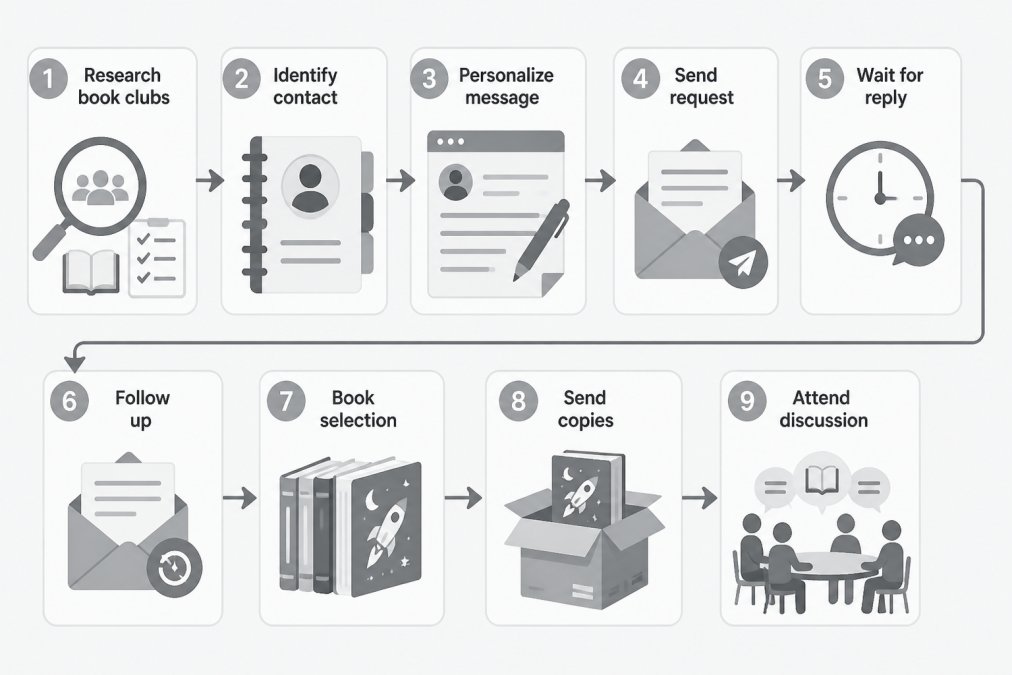
Reaching book clubs takes strategy. Here's how to do it right.
Research and list your target book clubs
Start by finding book clubs that read science fiction. Search "science fiction book clubs" plus your city or region. Check Goodreads for book club groups. Visit your local library website, many list book clubs that meet there.
Create a spreadsheet with:
- Club name
- Meeting location or format (in-person or virtual)
- Contact person and email
- Meeting frequency
- Book club size (if available)
- What subgenres they read
Look for clubs with 8-20 members. They're active enough to make a difference but small enough that your book gets real discussion time.
Focus on clubs that have read science fiction recently. A club that hasn't touched sci-fi in five years might not be your audience.
Personalize your outreach message
Generic emails get deleted; personal ones get read. Before you email, visit the club's website or social media and look for recent book selections. In your email, mention a specific book they've read: "I saw your club loved [Title] last month. My novel has that same [element they appreciated]." This shows you did your homework and respect their taste.
Keep your pitch short: one paragraph about your book, one sentence on why it fits them, and one clear ask, would they consider it for a future meeting? Include a link or offer to send a copy so it's easy to access.
Follow up and manage replies
Not every club responds, that's normal. Send your initial email, wait one week, then send one brief follow-up referencing your first message: "I wanted to follow up on my message about [Title].
When a club says yes, be responsive and professional. Send copies promptly, answer questions, and offer a video chat during their meeting if they want. After they discuss, ask if they'd share their thoughts. Some will post reviews; some will tell you directly.
Build Reader Community Beyond Initial Reviews
Your first readers aren't the end, they're the beginning. Every reader can become a voice for your book.
After people read your work, stay in touch. Build an email list, share updates about your next book, ask readers to post reviews on Goodreads or Amazon, and invite them to a reader group on Facebook or Discord.
When you're working on your next book, reach back out to your first readers and ask them to beta read again. They already know your style and are invested in your success.
Common Mistakes to Avoid When Finding Science Fiction Readers
Knowing what not to do saves time and protects your reputation.
Blasting generic emails to hundreds of bloggers and book clubs. Personalization matters.
Asking for five-star reviews before people read your book. This looks desperate and dishonest.
Ignoring feedback because it's not what you wanted to hear. Readers tell you what works and what doesn't.
Giving up after one round of outreach. Finding readers is ongoing work.
Being pushy or entitled. Reviewers and book clubs don't owe you anything.
Finding readers for your science fiction book takes work, but it pays off.
At ReaderReach, we help authors simplify this entire process.
Frequently Asked Questions
How do I find science fiction book clubs that might want to read my book?
Start by searching online for book clubs focused on science fiction or speculative fiction. Check social media groups, Goodreads communities, and local library websites. Look for clubs that have reviewed or featured books similar to yours. When you find promising groups, review their selection history and member activity to confirm they're active and match your target audience. Genre-specific forums and reader communities often list book club contacts and preferences.
What's the difference between beta readers, ARC readers, and book reviewers for science fiction?
Beta readers give feedback on your manuscript before publication to help you improve the story. ARC (Advanced Reader Copy) readers receive finished copies before launch and typically provide reviews for promotion. Book reviewers, especially those with blogs or platforms, publish reviews publicly to influence other readers. Each serves a different purpose: beta readers refine your work, ARC readers build pre-launch buzz, and reviewers extend your reach to their audiences.
How should I approach a science fiction book reviewer or blogger about reviewing my book?
Research their blog or platform first to confirm they review science fiction in your subgenre. Send a personalized message that mentions a specific book they've reviewed and explains why your story fits their interests. Keep your pitch brief and honest about your book's premise, target audience, and publication date. Provide a free review copy and ask if they accept unsolicited submissions. Respect their guidelines and timeline, reviewers receive many requests and appreciate authors who follow their stated process.
What information should I include when reaching out to a science fiction book club about featuring my book?
Share your book's title, subgenre, premise in 2-3 sentences, and why it matches their club's interests. Include your author bio, publication date, and a professional headshot if possible. Mention any special offerings, such as participating in a virtual discussion or providing discussion questions. Be clear about what you're requesting, a book selection, a review, or an author visit. Make it easy for them to access your book and contact you with questions.