Table of Contents
- Quick Comparison: Top 5 Platforms for Genre-Specific Book Clubs
- How We Evaluated These Genre-Specific Book Club Platforms
- 1. Goodreads: The Giant with Genre Groups and Reading Challenges
- 2. StoryGraph: Data-Driven Genre Filtering and Reading Progress Tracking
- 3. Fable: Social Reading with Virtual Discussion and Real-Time Chat
- 4. Bookclubs: Organizing Personal Digital Libraries and Subscription Services
- 5. LibraryThing: Book Cataloging, Author Discovery, and Local Library Integration
- Book Club Outreach Templates for Authors: A Practical Starting Point
- Frequently Asked Questions
Last Updated: September 30, 2026
Quick Comparison: Top 5 Platforms for Genre-Specific Book Clubs
Finding a book club that actually matches your reading taste is harder than it should be. The top platforms for finding genre-specific book clubs in 2026 are Goodreads, StoryGraph, Fable, Bookclubs, and LibraryThing. Each one handles genre filtering, discussion, and reading tracking differently, and the right pick depends on whether you want sheer community size or precise genre matching.
Below, we compare all five platforms side by side, then break down exactly who each one suits best.
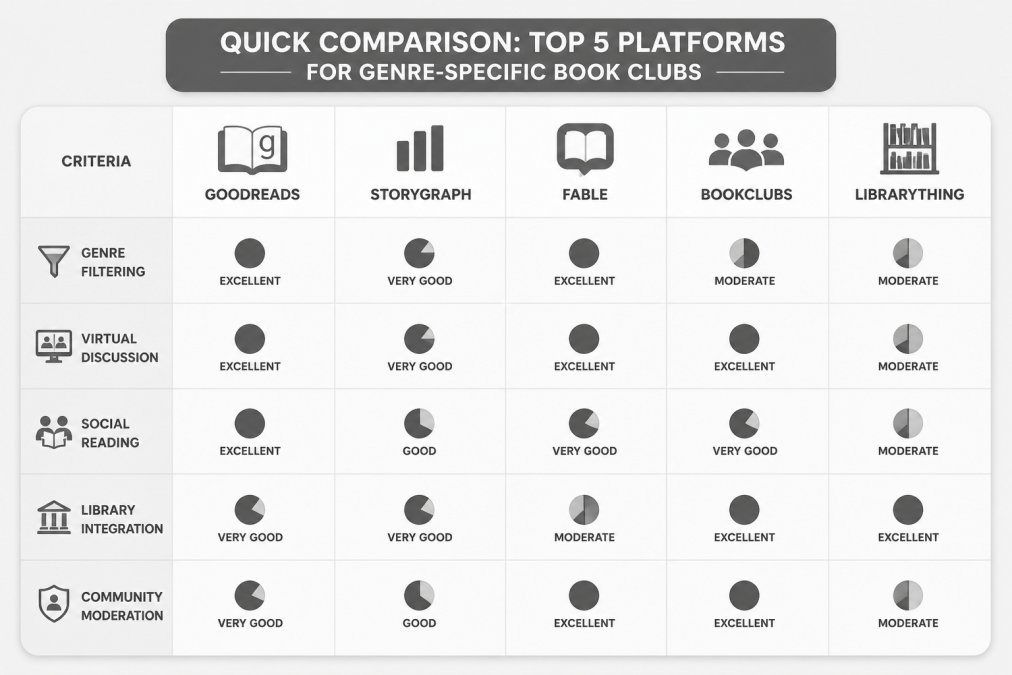
| Platform | Best For | Genre Filtering | Virtual Discussion | Library Integration |
|---|---|---|---|---|
| Goodreads | Largest community | Broad genre groups | Group forums | Limited |
| StoryGraph | Data-driven readers | Advanced subgenre filters | Light | None |
| Fable | Social reading | Curated genre clubs | Real-time chat | None |
| Bookclubs | Organizing groups | Moderate | Scheduling tools | None |
| LibraryThing | Catalogers and local readers | Tag-based | Group forums | Strong |
How We Evaluated These Genre-Specific Book Club Platforms
We judged each platform on five things: how well it filters by genre and subgenre, how its discussion tools work, whether it supports social reading, how it handles moderation, and whether it connects to your local library. Community size mattered less than match quality. A smaller club that loves your genre beats a huge group that never reads it.
That last point is the part most guides miss. A platform with millions of users is useless if none of them read what you read.
1. Goodreads: The Giant with Genre Groups and Reading Challenges
Goodreads is still the default starting point for genre readers, mostly because its Groups directory is enormous. You can search by genre tag and land in spaces like "Cozy Mysteries," "Hard Science Fiction," "Historical Romance," or "Horror Aficionados", groups that have been running for years and have thousands of members. Reading Challenges add a goal-setting layer that keeps people active across the calendar year, and the annual challenge feature is one of the few things that reliably pulls lapsed members back in.
The real skill with Goodreads is filtering past the noise. A search for "fantasy" returns hundreds of groups, and many are dormant. Before joining, check three signals: the date of the most recent discussion post, the number of active moderators listed, and whether the group has a pinned "current read" thread. If the newest post is more than a month old, the group has likely gone quiet.
Subgenre depth is where Goodreads genuinely shines. Because the platform is so large, you can find hyper-specific communities, "Vintage Mysteries," "YA Paranormal," "Military SF", that simply do not exist on smaller platforms. The trade-off is that discussion quality varies wildly. Some groups are tightly moderated with clear rules and scheduled reads; others are free-for-alls where promotional posts drown out conversation. Moderation is handled by volunteer moderators, and Goodreads itself does not vet group content, so the experience depends entirely on who is running the space.
A practical workflow: use Goodreads to identify which subgenres have active communities, then decide whether the group's pace and tone match how you like to read.
Pros and Cons of Goodreads for Genre Readers
Pros:
- Largest selection of genre and subgenre groups anywhere
- Reading Challenges and progress tracking built in
- Strong book metadata, author pages, and listopia features
- Easy to find hyper-specific niche communities
Cons:
- Discussion quality varies dramatically by group
- Interface feels dated compared to newer apps
- Moderation is inconsistent and volunteer-dependent
- Promotional posts can overwhelm smaller groups
2. StoryGraph: Data-Driven Genre Filtering and Reading Progress Tracking
StoryGraph's edge is precision. Instead of a single genre tag, every book carries a set of attributes, mood (dark, emotional, lighthearted), pace (fast, medium, slow), and content warnings, and you can filter recommendations by combining them. Want a slow-paced, emotional historical fiction with no graphic violence? You can build that query. That level of filtering is why readers with very specific tastes often prefer it to Goodreads.
Pros and Cons of StoryGraph for Niche Genre Communities
Pros:
- Best-in-class subgenre, mood, and pace filtering
- Detailed reading stats and progress tracking
- Built-in content warnings for safer discovery
- Strong recommendations for niche tastes
Cons:
- Smaller discussion community than Goodreads
- Fewer permanent, always-on group forums
- No local library integration
- Moderation response can be slow
3. Fable: Social Reading with Virtual Discussion and Real-Time Chat
Fable leans into social reading. Clubs run inside the app with real-time chat, so conversation happens as people read rather than after. Curated genre clubs give newcomers an easy entry point, and the interface feels modern and friendly.
Pros and Cons of Fable for Interactive Reading
Pros:
- Real-time chat keeps discussion lively
- Clean, modern interface
- Curated genre clubs for easy joining
Cons:
- Chat format buries longer thoughts
- Limited moderation tools
- No local library connection
4. Bookclubs: Organizing Personal Digital Libraries and Subscription Services
Bookclubs focuses on the logistics. You can schedule meetings, run polls on the next pick, and organize your personal digital library in one place. Subscription-based book services and reading lists sit alongside your group's calendar, which keeps everything in one spot.
Pros and Cons of Bookclubs for Community Engagement
Pros:
- Excellent scheduling and polling tools
- Keeps your reading list organized
- Good for running an existing club
Cons:
- Weaker genre discovery
- Smaller public community
- Fewer social features
5. LibraryThing: Book Cataloging, Author Discovery, and Local Library Integration
LibraryThing is the cataloger's platform. Tag-based organization lets you build a personal digital library with real precision, and author discovery tools surface writers you would never find through algorithms. Its strongest feature is local library integration, which connects your catalog to nearby collections.
Pros and Cons of LibraryThing for Avid Readers
Pros:
- Powerful book cataloging and tagging
- Strong author discovery tools
- Real local library integration
Cons:
- Dated interface
- Slower community pace
- Steeper learning curve
Book Club Outreach Templates for Authors: A Practical Starting Point
Here is a template you can adapt:
Subject: A [genre] pick for [Club Name]?
Hi [Organizer Name],
I noticed [Club Name] recently read [Recent Title]. My new [genre] novel, [Your Title], explores a similar theme, and I think your members would enjoy the discussion it opens up.
I would be glad to send review copies, join a meeting by video, or answer questions. No pressure either way.
Thanks for the work you put into the club.
[Your Name]
This is where ReaderReach fits for authors who would rather write than chase organizers. ReaderReach researches genre-matched clubs and manages personalized outreach campaigns on your behalf, handling replies and follow-ups through its Campaign Desk. That means one book club selection can reach dozens of readers at once, and each one becomes a chance for reviews, interviews, or author visits. For independent authors building a readership foundation, that systematic approach saves hours every week.
Frequently Asked Questions
What is the best platform for organizing genre-specific book clubs?
It depends on your priorities. For large genre communities and reading challenges, Goodreads works well. For data-driven genre filtering and reading progress tracking, StoryGraph is strong. Fable excels at virtual discussion and real-time chat. Bookclubs simplifies organizing personal digital libraries, and LibraryThing offers book cataloging with local library integration. Try two or three to see which fits your group's habits.
How can authors connect with genre-specific book clubs?
Start by identifying platforms where your genre has active communities. Use genre filtering to find groups that match your book's subgenre and publication date range. Then reach out with a personalized message that references the group's recent reads. ReaderReach handles this research and outreach for authors, matching titles to book clubs and managing follow-ups so you can focus on writing.
What features should I look for in a book club platform?
Prioritize genre filtering, virtual discussion tools, reading progress tracking, and community moderation. If you value peer reviews and curated lists, look for platforms with strong user-generated content. For local ties, check integration with local libraries. Also consider whether the platform supports subscription services or one-time group setups, and how easy it is to organize your reading list.
Are there online platforms specifically for genre-based reading groups?
Yes. StoryGraph and Goodreads both have dedicated genre groups, from literary fiction to niche subgenres. Fable hosts interactive reading clubs with real-time chat. Bookclubs is built for organizing groups around specific books or themes. LibraryThing connects catalogers with genre communities. Each platform's genre filtering and community engagement tools vary, so match the platform to how your group likes to read and discuss.
Building a readership takes more than a good book. It takes reaching the right readers in the right rooms. ReaderReach connects independent authors to genre-matched book clubs, libraries, and reading circles through managed outreach campaigns, with a dedicated author identity, daily follow-up, and reply triage handled for you. Get started with ReaderReach and turn your next club selection into lasting reader engagement.