Table of Contents
- How Local Author Events Drive Real Sales Growth
- The Hidden Benefits Beyond Immediate Book Sales
- Building Community and Local Recognition Through Events
- How to Get More Reviews for Your Book at Local Events
- Author Event Outreach Templates That Actually Work
- Book Club Outreach for Authors: Your Most Valuable Channel
- Tracking Event ROI and Managing Expectations
- Frequently Asked Questions
Last Updated: October 2, 2026
How Local Author Events Drive Real Sales Growth
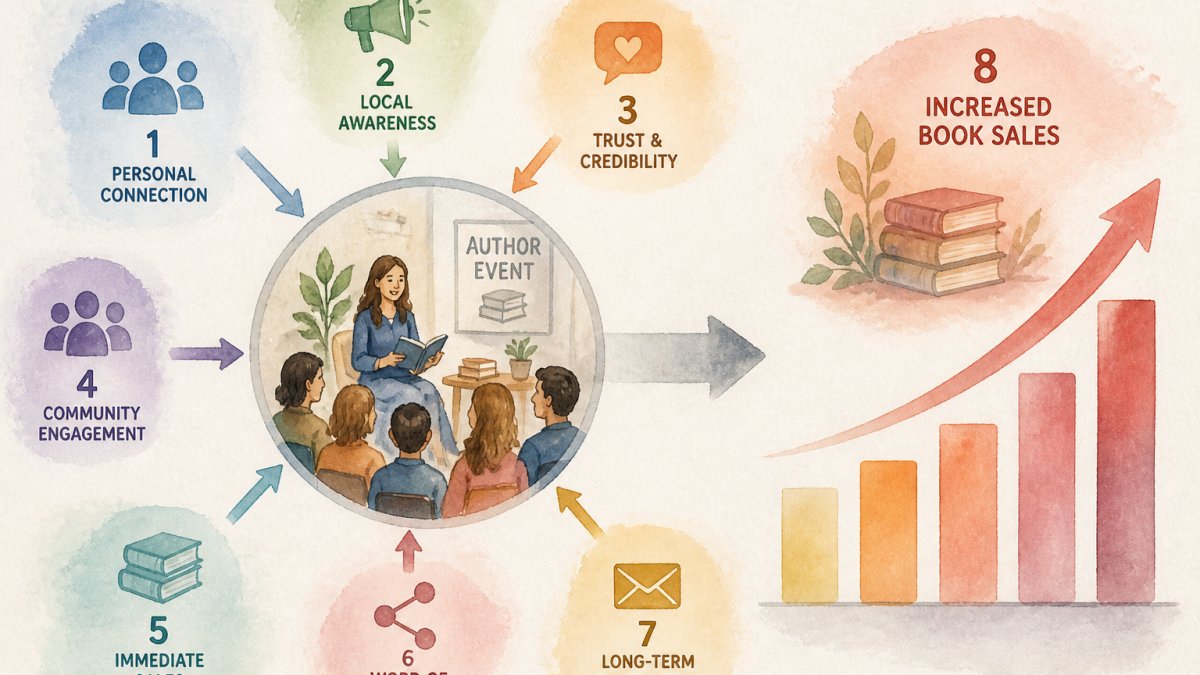
Local author events aren't just about selling a few books at a signing table. They're about creating moments where readers connect with your story, remember your name, and become the kind of people who recommend your book to others. Understanding why local author events increase book sales reveals that the real engine is this deeper reader connection, not the immediate transaction.
When you show up in person, something shifts. Readers see you as a real person, not just a name on a spine. They ask questions about your characters. They tell you which scene made them cry. And here's what matters for your bottom line: they're exponentially more likely to leave reviews, join your email list, and buy your next book when it launches.
According to Author Marketing Institute research, authors who participate in local events report higher engagement rates with their reader communities compared to those relying solely on online marketing. The difference isn't marginal, it's the foundation that separates authors building lasting careers from those struggling to find their audience.
The Hidden Benefits Beyond Immediate Book Sales
Most authors measure event success by how many books they sold that day. That's thinking too small.
The real value of local author events compounds over time. A reader who meets you at a book fair and buys your book isn't just a one-time transaction. They're a potential recurring customer, a review source, and a word-of-mouth ambassador for everything you write next.
Here's what actually happens when you engage readers in person:
Review generation becomes natural. Readers who meet you face-to-face are significantly more willing to leave reviews. They've made a personal connection. They know you care. A simple conversation at an event, "I'd love to hear what you think when you finish", plants the seed. Many of those readers will follow through.
Email list growth accelerates. At an event, you can directly ask readers to join your list. No complicated opt-in process. No algorithm deciding whether they see your message. Just a conversation: "I send monthly updates about upcoming releases and exclusive content. Want in?" The conversion rate from event attendee to email subscriber is substantially higher than cold digital marketing.
Local recognition builds authority. When readers see you as part of their community, speaking at libraries, appearing at bookstores, participating in literary circles, you stop being a distant author name. You become a local figure. That perception matters. It influences purchasing decisions, review likelihood, and whether readers recommend you to friends.
Networking opens doors. Every author at an event is a potential collaborator. Bookstore owners remember you. Library coordinators think of you for future programming. Other authors become allies who can cross-promote your work. These relationships compound into opportunities you can't manufacture online.
Building Community and Local Recognition Through Events
Your local market is your foundation. It's where you build the kind of deep reader relationships that sustain a writing career.
When you participate consistently in local events, book fairs, library readings, bookstore signings, author panels, you become part of the literary community. Readers start to recognize you. They anticipate your appearances. They tell friends: "There's this author who does readings at the library every month. You should come."
That consistency matters more than the size of any single event. A small bookstore reading you do regularly beats an occasional appearance at a major literary festival. Why? Because readers see you as committed to your community, not just passing through to sell books.
The psychology of the "local" label is powerful. Readers prefer supporting local authors. They feel invested in your success. They're more forgiving of imperfections in early work. They're more likely to give your second book a chance. They're more likely to show up to your next event.
This is where ReaderReach's approach makes a difference. Rather than treating events as isolated sales opportunities, we help authors think about local author events as part of a sustained community engagement strategy. That means identifying the book clubs, reading circles, and literary communities that actually align with your genre and reader profile. It means showing up repeatedly, building relationships, and creating a network of readers who expect your next book.
The authors who build real careers through local events aren't the ones trying to maximize sales at every single appearance. They're the ones building relationships that last years.
How to Get More Reviews for Your Book at Local Events
Reviews are currency in publishing. They influence visibility, credibility, and purchasing decisions. Local events are one of your most effective review-generation channels, if you approach them strategically.
Here's what actually works:
Make the ask personal and specific. Don't hand someone a business card that says "Leave a review." Instead, during your conversation at the event, ask directly: "When you finish reading, would you be willing to leave a review on Amazon or Goodreads? It genuinely helps me reach more readers like you." That personal request converts at a much higher rate than any generic call-to-action.
Provide a frictionless path. Have a QR code on a bookmark or handout that links directly to your book's review page. Make it one click. The easier you make it, the higher your completion rate.
Follow up within days. The emotional connection from meeting you in person fades quickly. Send a warm email within 48 hours: "It was great meeting you at [event name]. I hope you enjoy the book. If you do, I'd be grateful for a review." Include that same QR code link. Many readers will follow through if you remind them while the memory is fresh.
Incentivize selectively. Some platforms prohibit incentivized reviews, so check the rules. But you can offer something that doesn't violate guidelines: early access to your next book, exclusive short stories, or entry into a drawing for readers who email you a screenshot of their review. This works particularly well with book club members who are already engaged readers.
Use the book club advantage. If you visit a book club, you've got a captive audience of readers who've already finished your book and discussed it together. They're primed to leave reviews. A simple group ask, "As a thank you for having me, I'd love if you'd all consider leaving a review", often results in multiple reviews within days.
Author Event Outreach Templates That Actually Work
Getting invited to events requires outreach. Most authors either don't do it or do it wrong, generic emails that get deleted immediately.
Here's a template framework that works:
For bookstore owner outreach:
Subject line: "Author event idea for [bookstore name]"
Hi [Owner/Manager name],
I'm [Your Name], author of [Book Title]. I've been a customer at [Bookstore Name] for [timeframe], and I love how you curate books for [your community/neighborhood].
I'm reaching out because I think my readers would connect with your store. [Book Title] is about [one-sentence premise that connects to their community or customer base].
I'd love to host a reading or signing at your store.
Would [specific date/timeframe] work for you? I'm flexible.
Thanks for considering, [Your Name] [Website/Email]
For library programming coordinator:
Subject line: "Author visit proposal, [Book Title]"
Hi [Coordinator name],
I can offer:
- A 45-minute reading and Q&A
- Discussion guides for book clubs
- Follow-up virtual events if helpful
Best, [Your Name]
For book club outreach:
Subject line: "Author visit for [Book Title]"
Hi [Book club contact],
Would your group be interested? I'm available [give timeframe].
Thanks, [Your Name]
Book Club Outreach for Authors: Your Most Valuable Channel
Book clubs are the most underutilized marketing channel for independent authors. They're also your highest-ROI reader acquisition opportunity.
That's exponentially better ROI than most marketing efforts.
How to approach book club outreach:
Tracking Event ROI and Managing Expectations
Here's the uncomfortable truth: most local author events won't generate a spike in sales. At least not immediately.
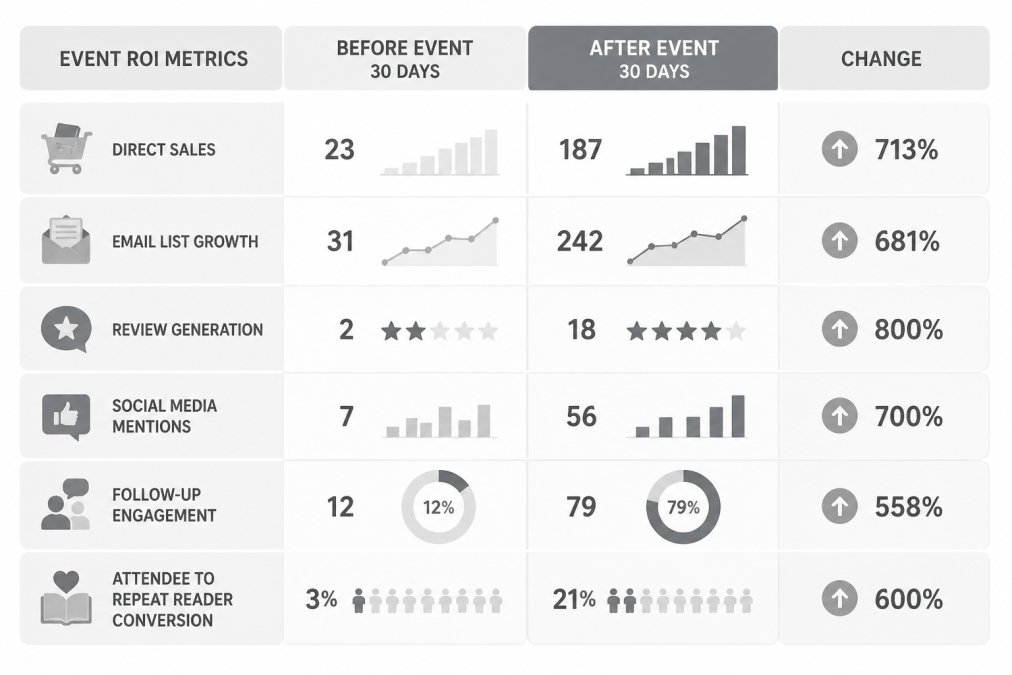
Metrics that actually matter:
| Metric | How to Measure | Why It Matters |
|---|---|---|
| Email subscribers gained | Track signups with a QR code or clipboard | Direct access to readers for future launches |
| Review commitments | Ask attendees directly; note names | Reviews drive visibility and credibility |
| Book club referrals | Track which clubs contact you post-event | Book clubs generate compound reader growth |
| Attendee-to-customer conversion | Compare email list size before/after; track purchases | Measures whether attendees actually buy |
| Follow-up engagement | Track email open rates and clicks from event attendees | Shows which readers are genuinely interested |
| Social media mentions | Monitor tags and mentions from event attendees | Extends reach beyond the event itself |
Before each event, set realistic expectations:
Frequently Asked Questions
Are local author events worth the time for independent authors?
Yes, but only with the right strategy. Local author events create direct contact with readers, which builds trust and generates word-of-mouth promotion that paid advertising can't replicate. The real value lies beyond immediate sales: event attendees often become your most engaged readers, leave reviews, and recommend your book to others. Track metrics like email signups, reviews gained, and repeat purchases to see the full ROI, not just books sold at the event itself.
How can I measure the success of a local event beyond immediate sales?
Track these metrics: email addresses collected, social media followers gained, reviews posted within 30 days, inquiries from book clubs or reading circles, and follow-up purchases from attendees. Use a unique discount code or landing page to identify which sales came from the event. Survey attendees about what drew them and whether they'd recommend your book. This data shows whether your event built lasting community engagement, not just one-time transactions.
What's the best way to use book club outreach for authors to maximize event attendance and sales?
Book clubs are your highest-value audience because members read deeply and influence each other. Reach out to clubs that match your genre with a personalized pitch, mention the book's themes and why their group would connect with it. Offer to attend a meeting or host a virtual Q&A. Members who engage with you directly become invested in your success and often purchase copies for their group. This approach turns one event into multiple sales plus genuine reader relationships.
How do I use author event outreach templates to save time without sounding generic?
Start with a template structure but customize the opening line with something specific about the venue or audience. Mention the book's core theme and why it fits that particular location or group. Include a clear call-to-action (ask for a specific date or event type). Templates save you from writing each pitch from scratch, but personalization is what gets responses. Test which opening lines and offers get the highest reply rate, then refine your template based on what works.