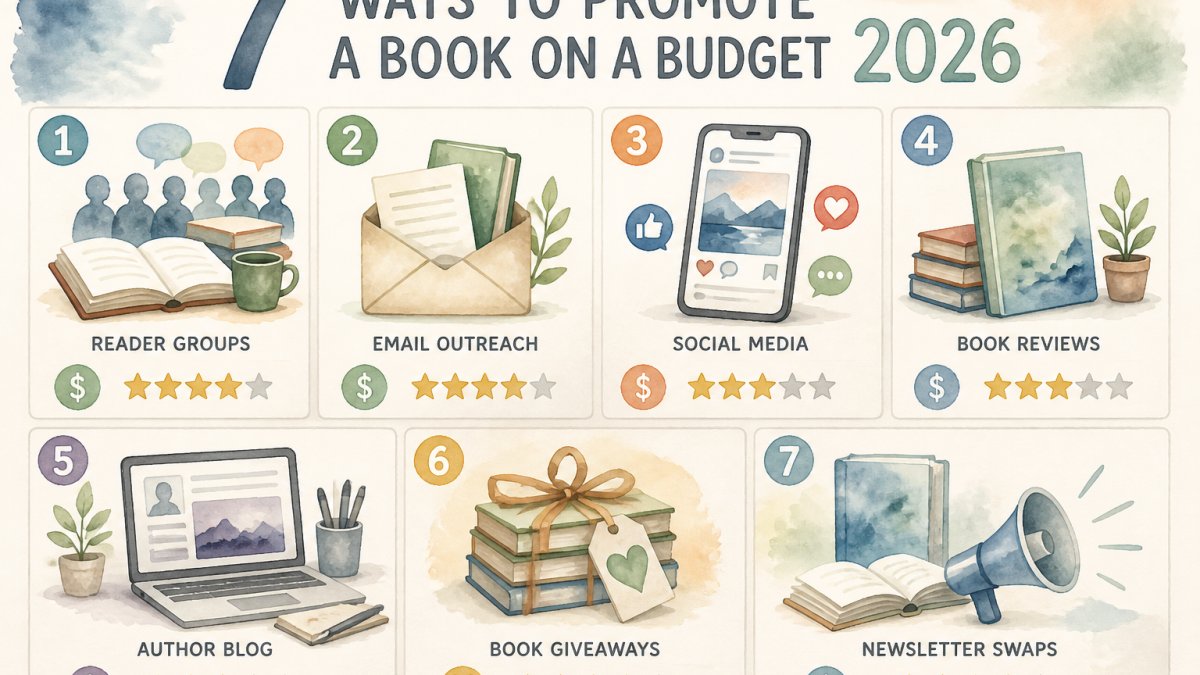
Table of Contents
- Build Your Author Website and Email List
- How to Get More Reviews for Your Book
- Book Club Outreach for Authors on a Budget
- Develop a Book Marketing Plan for Authors
- Book Promotion Ideas for Independent Authors
- Use AI-Assisted Marketing Workflows to Save Time
- Build Community and Network With Other Authors
- Frequently Asked Questions
Last Updated: October 9, 2026
Build Your Author Website and Email List
Your website is the foundation of your book marketing. It's where readers find you when they search your name. It's where they sign up for your mailing list. It's where you control the conversation, not relying on social media algorithms.
Most authors skip this step. They think social media is enough. It's not. Social media platforms change their rules constantly. Your followers disappear overnight. Your posts get buried. A website stays yours forever.
Here's what your author website needs:
- A clear homepage that explains who you are and what you write
- A dedicated page for each book with the cover, blurb, and where to buy
- An email signup form (your reader magnet) on every page
- Links to your social media and podcast appearances
- A simple blog or news section for updates
Creating reader magnets and email opt-ins
A reader magnet is something free that gets people to join your email list. It could be:
- The first chapter of your book
- A short story set in your book's world
- A character guide or world-building document
- A downloadable checklist related to your genre
- Behind-the-scenes photos or writing tips
The key is making it valuable enough that readers want it. Don't just ask for emails with nothing in return. Give them something they actually want.
Once someone joins your list, send them a welcome email. Then send regular updates about your writing, new releases, and book club opportunities. Most authors send one email per month. Some send weekly. Find a rhythm you can stick with.
How to Get More Reviews for Your Book
Reviews are currency in the book world. They signal to other readers that your book is worth their time. Algorithms favor books with more reviews.
The challenge is getting those first reviews without paid services. Here's how to do it for free.
Free review platforms and reader communities
Start with Goodreads. Goodreads has millions of active readers (T.J. Slee's Blog - Who is the average Goodreads user? You'll be surprised!).
Join reader communities where your genre lives:
- Reddit communities for your genre (r/RomanceAuthors, r/Fantasy, etc.)
- Goodreads groups focused on your genre
- Facebook groups for readers who love books like yours
- BookTok communities and Discord servers
- LibraryThing groups
Don't spam these communities. Join them as a real person. Participate in discussions. Answer questions. When you mention your book, do it naturally and rarely.
Asking readers directly without paid services
Your best reviewers are your existing readers. Ask them directly. Send an email to your list asking for reviews. Most won't respond, but some will.
Make it easy for them. Include direct links to Goodreads, Amazon, and other review platforms. Don't make them search for where to leave a review.
Send a follow-up email a week later if you don't see many reviews. People forget. A reminder helps.
Consider creating a simple form on your website where readers can submit reviews.
Book Club Outreach for Authors on a Budget
Book clubs are where real reader engagement happens. One book club selection can reach dozens of readers at once. Those readers discuss your book.
This is the power of book club outreach.
Finding and researching local and online book clubs
Start with a simple Google search: "book clubs near me" or "[your genre] book clubs online." You'll find hundreds of options.
Create a spreadsheet with:
- Club name
- Contact person (if listed)
- Meeting format (in-person, online, hybrid)
- How often they meet
- What genres they read
- Contact email or social media
Look for clubs that have read books similar to yours. A romance book club won't pick a thriller. A sci-fi club won't pick historical fiction.
Check their social media. Read their recent reviews. Understand what they like. This research takes time, but it pays off in higher response rates.
Crafting personalized outreach that gets responses
Generic outreach gets deleted. Personalized outreach gets responses.
When you reach out, mention something specific about the club. Reference a book they recently read. Mention their reading preferences. Show that you actually know who they are.
Here's a simple template:
"Hi [Club Name] team,
I'm [Your Name], author of [Book Title].
[Book Title] is about [one-sentence hook]. It's perfect for book club discussion because [mention discussion angles].
I'd love to send you a free copy to consider for your next selection. I'm also available for a virtual author visit if you choose the book.
Thanks for considering, [Your Name]"
Keep it short. Keep it personal. Make it easy for them to say yes.
Clubs connect readers who become loyal fans.
Develop a Book Marketing Plan for Authors
A marketing plan doesn't have to be complicated. It just needs direction.
Start by answering these questions:
- Who reads your genre?
- Where do those readers spend time (online and offline)?
- What problem does your book solve for them?
- Why is your book different from others in your genre?
Your answers become your marketing strategy.
Setting realistic goals and measuring what works
Set goals you can actually track. "Sell more books" is too vague. "Get 50 book club inquiries in the next 90 days" is specific.
Track what you do and what results you get:
- How many emails did you send? How many people opened them?
- How many book clubs did you contact? How many responded?
- How many reviews did you get this month?
- How many new email subscribers did you gain?
- Where did your sales spike? What caused it?
You don't need fancy tools. A simple spreadsheet works. The point is noticing patterns. What gets results? Do more of that. What doesn't work? Stop doing it.
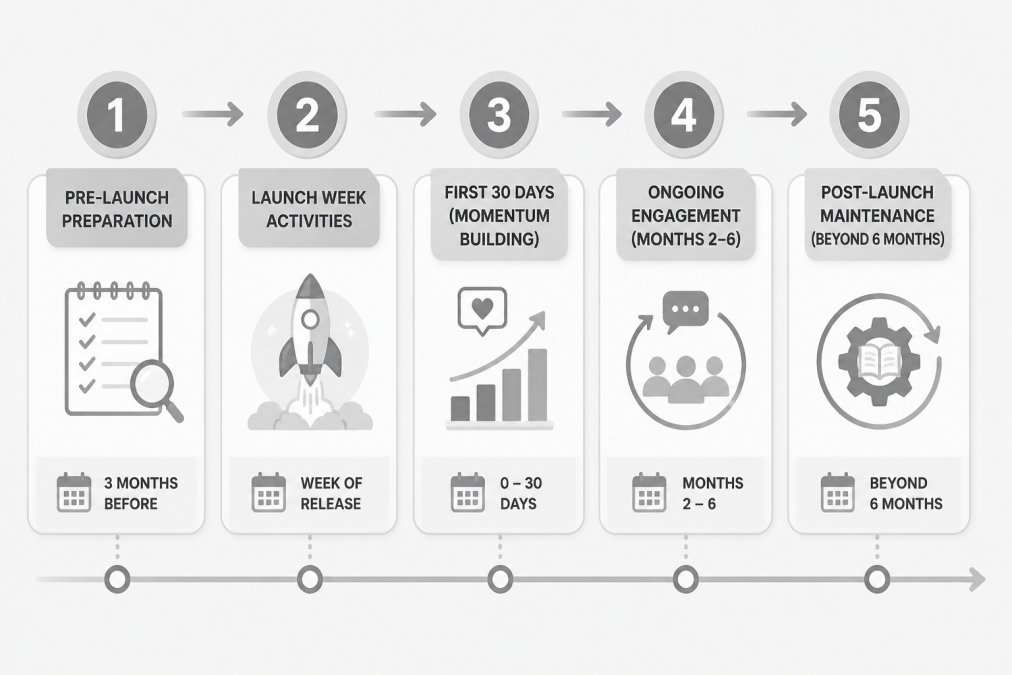
Post-launch maintenance: keeping momentum going
Most authors launch their book and then disappear. They think the work is done. It's not.
The weeks and months after launch are critical. This is when you build reader relationships. This is when you secure book club selections. This is when word-of-mouth spreads.
Stay active in your communities. Keep emailing your list. Keep reaching out to book clubs. Keep asking for reviews. Keep showing up.
Many authors see their biggest sales spike three to six months after launch, not during launch week. This happens because they kept the momentum going.
Book Promotion Ideas for Independent Authors
You don't need a big budget to promote a book on a budget. You need creativity and consistency.
Using social media without spending money
Post regularly on the platforms where your readers hang out. For most authors, that's Instagram, TikTok, or Facebook.
Share:
- Quotes from your book
- Writing process updates
- Character insights
- Behind-the-scenes photos
- Reader reviews and reactions
- Snippets of your next book
Post at least three times per week. Consistency matters more than perfection. A regular, authentic voice builds followers. A sporadic, polished account gets ignored.
Engage with other authors and readers. Reply to comments. Ask questions. Start conversations. Social media is social. Treat it that way.
Podcast appearances and radio interviews
Podcasts are hungry for content. Thousands of podcasts need guests. Many of them would love to interview an author.
Find podcasts in your genre or related topics. Listen to a few episodes. Then reach out to the host. Explain why you'd be a great guest.
Prepare talking points about your book, your writing journey, and why listeners should care. A good podcast interview reaches thousands of people. Many of them will check out your book.
Radio interviews work similarly. Local radio stations often interview local authors. Contact your local station and pitch yourself.
Use AI-Assisted Marketing Workflows to Save Time
AI tools can handle repetitive tasks. This frees you up to do the creative work only you can do.
Automating email sequences and outreach tracking
Set up an automated welcome email sequence for new subscribers. When someone joins your list, they automatically get a series of emails introducing your book and your writing.
Use a tool to track your book club outreach. Log each contact you make. Track responses. Set reminders for follow-ups. This keeps you organized without manual effort.
AI can help you draft outreach emails. You still personalize them, but the AI handles the heavy lifting of structure and tone.
AI tools for content creation and metadata optimization
Use AI to help write social media captions, email subject lines, and book descriptions. The AI does the first draft. You refine it to match your voice.
Use AI to research keywords for your book's metadata. Better metadata means better discoverability on Amazon and other platforms.
Use AI to analyze your email open rates and click rates.
The goal is working smarter, not harder. AI handles the data work. You handle the relationships and creativity.
Build Community and Network With Other Authors
Authors who help each other succeed. Authors who compete with each other struggle.
Newsletter swaps and cross-promotion
Partner with another author in your genre. You email her book to your list. She emails your book to her list. Both of you reach new readers for free.
This works because you're recommending something you actually believe in. Your readers trust your recommendations.
Mention each other on social media. Share each other's posts. Tag each other in relevant conversations. Build genuine relationships with other authors.
Street teams and reader advocacy on a shoestring
A street team is a group of your most loyal readers who help promote your book. They don't need to be formal or official.
Ask your email list: "Would you like to help promote my book?" Some will say yes. Those people become your street team.
Give them tools to help:
- Social media graphics they can share
- A paragraph they can post about your book
- Links to leave reviews
- Hashtags to use
They promote because they love your book. They feel like part of something. This creates real advocates, not paid promoters.
Author communities are where sustainable growth happens.
Getting your book into readers' hands when you promote a book on a budget doesn't require a massive budget. It requires a strategy, consistency, and genuine connection with your audience.
Frequently Asked Questions
How can I promote a book with little or no budget?
Focus on organic reach through your author website, email list, and direct outreach to book clubs and reader communities. Build a reader magnet (free excerpt, bonus chapter) to grow your mailing list without paid ads. Reach out personally to book bloggers and podcasts for interviews. Use social media engagement rather than paid promotions. The most cost-effective promotion happens when you identify your target audience and connect with them directly through communities they already inhabit.
How can book clubs help promote an independent author?
Book club selections create multiple reader touchpoints: the club members read your book, discuss it, and often leave reviews. One book club selection can reach 10-30 readers at once, multiplying your impact. Book clubs also generate opportunities for author visits, Q&A sessions, and interviews that build social proof and community engagement. This is why book club outreach for authors is one of the highest-ROI tactics, you're reaching engaged readers who become advocates for your work.
How do I know which promotion ideas will actually work for my book?
Test one tactic at a time and measure results. For email campaigns, track open rates and click-through rates. For book club outreach, count responses and conversions to actual selections. For social media, look beyond vanity metrics to engagement that leads to sales or reviews. Platform-specific ROI analysis means comparing effort spent (hours) to readers gained or reviews earned. Start with the tactics that match your genre and audience, then double down on what produces measurable results.