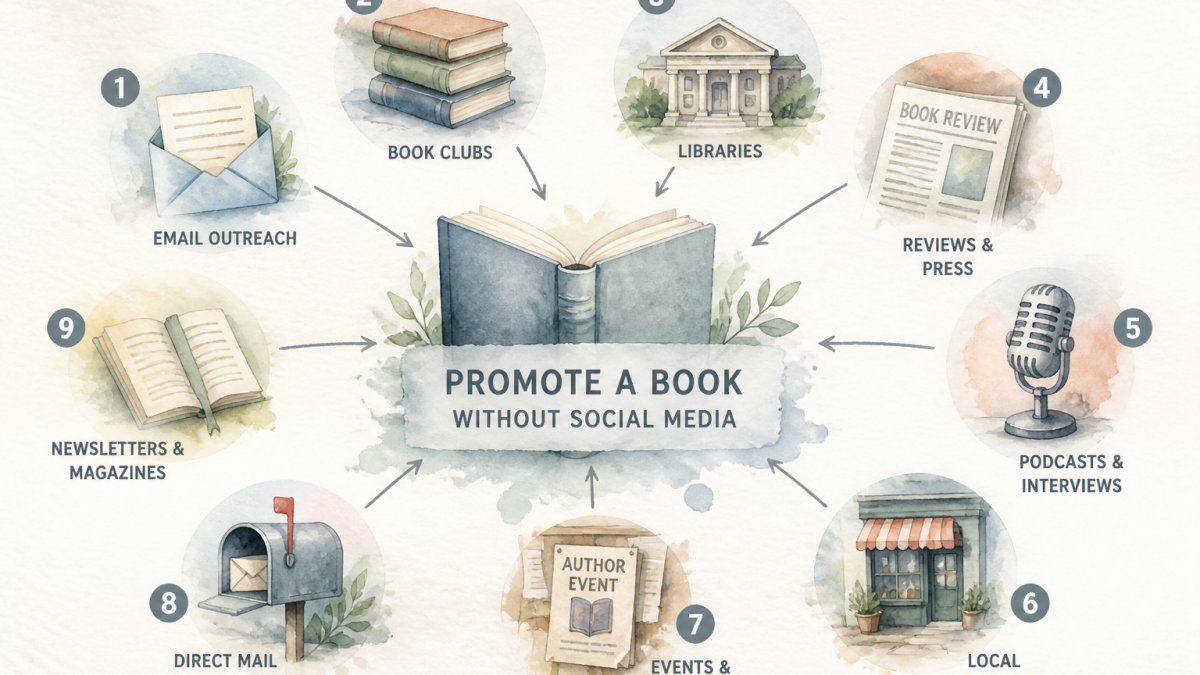
Table of Contents
- Why Book Promotion Beyond Social Media Actually Works
- Build Your Author Newsletter and Email List
- Create a Website and Author Platform
- How to Get Book Reviews Without Social Media
- How to Pitch a Book to a Book Club
- Launch Your Book with a Strategic Marketing Plan
- Host Readings, Signings, and Local Events
- Reach Readers Through Podcasts, Radio, and Guest Appearances
- Final Thoughts
- Related Reading
- Frequently Asked Questions
Last Updated: October 13, 2026
Why Book Promotion Beyond Social Media Actually Works
Most authors assume social media is the only way to reach readers, but you can promote a book without social media by building real connections instead.
Algorithms change constantly and followers disappear overnight, but an email list, a book club connection, or a library partnership sticks.
The strategies below focus on book promotion without social media by building real connections with readers who already love books and are actively looking for their next read.
Build Your Author Newsletter and Email List
Your email list is the most valuable asset you can build.
Start building your list today, even before your book launches. Here's how:
- Create a simple signup form on your website or use a free email service
- Offer a bonus to encourage signups (a free chapter, a short story, a reading guide)
- Ask readers directly at events, in your author bio, and anywhere you interact online
- Make it easy to find by placing signup links prominently
Once you have subscribers, send regular emails. Monthly updates work well for most authors. Share writing updates, behind-the-scenes stories, or book recommendations.
An author newsletter builds trust over time. When your book launches, subscribers become your first readers and best advocates, leaving reviews, recommending your book, and attending events.
Create a Website and Author Platform
A website gives you control. You're not dependent on any platform's rules or algorithms, it's yours forever.
Your author website doesn't need to be fancy. Include these essentials:
- A clear author bio with a photo and brief description
- Your book information with cover image, synopsis, and where to buy
- An email signup form (this is critical)
- A blog or news section where you share updates
A simple site takes a few hours to set up with free tools like Wix, Squarespace, or WordPress.
Your website also helps with book promotion without social media by serving as your central hub. Podcast interviews mention it, book club outreach links to it, and event flyers point people to it.
How to Get Book Reviews Without Social Media
Reviews drive book sales. Readers trust other readers' opinions more than marketing messages. But getting reviews doesn't require social media.
Start by reaching out to readers directly:
- Ask your email subscribers for reviews
- Contact book bloggers who cover your genre
- Send review copies to libraries and bookstores
- Pitch to podcasts that review books in your category
Book bloggers are hungry for new books to review.
Libraries often accept review requests too, some librarians write reviews or feature books in newsletters, reaching hundreds of local readers.
Be specific. Mention why a particular reviewer would love your book and reference their previous reviews, show you've done your homework.
How to Pitch a Book to a Book Club
Book clubs are goldmines. A single club can reach 10-20 engaged readers who talk to friends, leave reviews, and recommend your book.
Here's how to pitch a book club:
- Find book clubs in your genre using Google, Meetup, or local library listings
- Research the club by reading their recent picks and member reviews
- Write a personalized pitch explaining why your book fits their interests
- Offer something extra like a free discussion guide or author Q&A
- Follow up if you don't hear back after two weeks
Keep your pitch short and friendly. Mention specific books they've selected, explain how yours connects, and offer a discussion guide or Q&A to make their job easier.
Many clubs meet monthly and need recommendations. Authors who reach out directly often get selected, one of the most effective ways to build a dedicated readership.
Launch Your Book with a Strategic Marketing Plan
A launch plan gives structure to your efforts. Without one, promotion feels random and exhausting. Most timelines assume unlimited time and money.
This plan is built around three budget tiers, so you can pick the path that matches your reality.
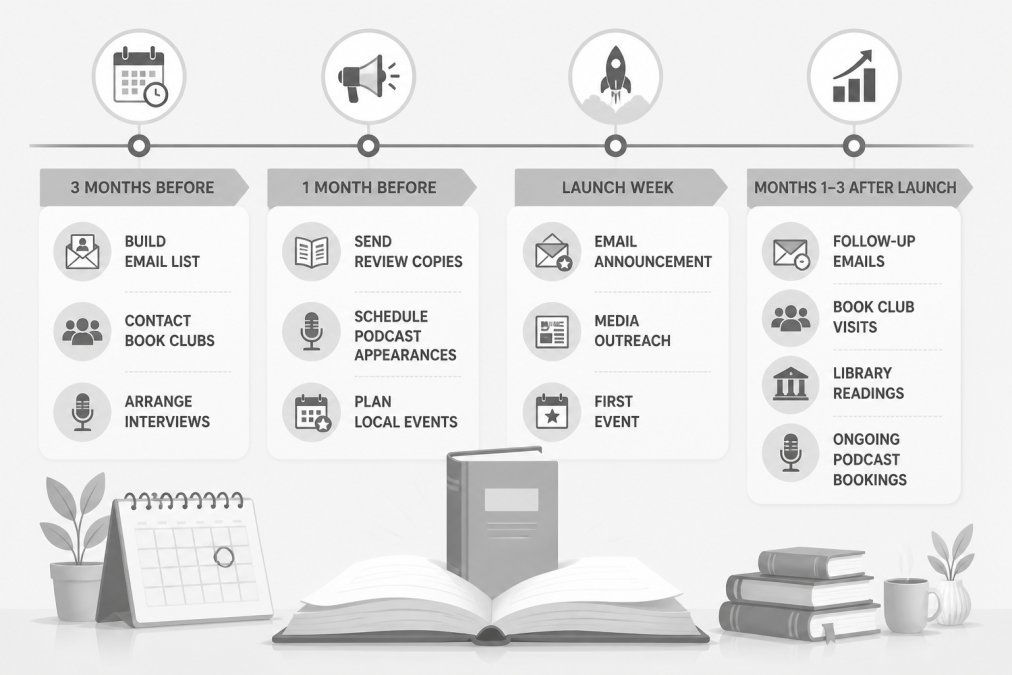
Pick your budget tier first
Tier 1, No budget (time only). You do everything yourself. Focus on your email list, your website, free podcast and blog pitches, library and bookstore outreach, and local events.
Tier 2, Small budget (a few hundred dollars). Add a paid email service tier so you can automate welcome sequences, a batch of print review copies, and a small run of bookmarks or postcards for events.
Tier 3, Larger budget (publicist or ads). This is when a publicist, a book promotion site campaign, or paid ads start to make sense.
The 90-day timeline (works for every tier)
Three months before launch:
- Finalize your email list and website
- Identify book clubs and podcasts to pitch
- Arrange author interviews
- Send review copies to bloggers and publications
One month before launch:
- Confirm podcast appearances and book club selections
- Schedule local events and readings
- Send launch announcement emails to your list
- Reach out to libraries about stocking your book
Launch week:
- Send a launch announcement to your email list
- Conduct podcast interviews
- Host a book launch event if possible
- Follow up with book clubs and media contacts
First three months after launch:
- Attend book club meetings (virtually or in person)
- Do podcast interviews
- Host readings and signings
- Continue building your email list
This timeline works for most authors. Adjust it based on your book's release date, your budget tier, and your availability. The order matters more than the exact dates, reviews and email subscribers compound, so they should always come first.
Host Readings, Signings, and Local Events
In-person events create memorable experiences. Readers who meet you become loyal fans, buying multiple copies, recommending your book, and attending future events.
Start local. Your community is your first audience.
- Contact local bookstores about hosting a signing
- Ask your library about author event space
- Reach out to cafes and restaurants that host author nights
- Connect with local writing groups and book clubs
A signing doesn't need hundreds of people. Ten engaged readers is a success, those ten will tell others about your book.
Prepare for events by:
- Creating simple flyers to promote the event locally
- Sending emails to your subscriber list with event details
- Reaching out to local media for coverage
- Preparing a short reading (5-10 minutes is perfect)
Events also give you content. Take photos, record short clips, and share stories, material for your newsletter and website.
Reach Readers Through Podcasts, Radio, and Guest Appearances
Podcasts reach millions of listeners, and many hosts actively seek author guests. This is one of the most effective ways to promote a book without social media, but only if you treat it as a system, not a one-off.
Where to actually find shows
- Podcast directories: Apple Podcasts, Spotify, and Listen Notes let you search by keyword. Search your genre, your book's topic, and adjacent interests.
- Podchaser and Rephonic (free tiers) let you filter by audience size and recent activity, so you're not pitching dead shows.
- Guest-booking communities: Podcast guest directories and Facebook groups for podcast guests and hosts are full of hosts looking for authors.
- Your own reading list: The nonfiction authors you admire have almost certainly been on podcasts. Look at their press pages and see which shows booked them.
What a pitch that gets a yes looks like
Keep it to three short paragraphs:
- One line on why this specific show. Reference a recent episode by name. "I loved your episode with [guest] on [topic], it's why I'm reaching out."
- One line on your angle. Not "I wrote a book." Instead: "I can talk about [specific, useful topic] for your audience, drawing on [your experience]."
- One line on logistics. Offer to send a review copy, a sample Q&A, and a headshot. Make it easy to say yes.
Turn one appearance into many
A single podcast episode is not the only goal. Consider what you do with it afterward:
- Ask the host for the episode link and add it to a dedicated "Press" page on your website.
- Mention a free bonus (a chapter, a reading guide) during the episode, and point listeners to a simple signup page. This is how you convert listeners into email subscribers.
- Follow up with the host a few weeks later with a thank-you and a note about your next project. Hosts book repeat guests.
- Pitch the same topic to adjacent shows. If a show about writing booked you, a show about creativity, business, or your book's subject may book you too.
Radio and guest articles
Radio stations also interview authors, especially local shows. A short, friendly email with your media sheet to your local NPR or community station is enough.
Guest articles work the same way. Pitch yourself as a guest writer for blogs, newsletters, or publications in your genre, write about something related to your book, and include a bio with your website link.
Each appearance reaches new readers and builds your credibility, which makes the next pitch easier.
Final Thoughts
Book promotion without social media is not only possible, it's often more effective.
These strategies take time but create sustainable growth.
ReaderReach helps authors simplify this process. Our platform connects you with genre-matched book clubs, manages outreach campaigns, and tracks opportunities for reviews, interviews, and events.
The readers you reach become your core audience, buying your books, attending events, and recommending you to others.
Related Reading
Learn more about author marketing strategies from Author's Guild resources on book promotion, which covers traditional and digital approaches to reaching readers. The Publishers Weekly guide to author platforms also offers practical advice on building your author presence. For podcast marketing specifically, check out Podcast Guest Handbook by Podbean, which helps authors prepare for interview appearances.
Frequently Asked Questions
What are the best ways to promote a book without social media?
Direct outreach to book clubs, building an email newsletter, securing podcast and media interviews, and hosting local readings and events are among the most effective methods. Email lists and newsletters create lasting reader relationships because subscribers actively choose to hear from you. Book clubs offer word-of-mouth amplification through group discussions. Podcasts and radio interviews reach engaged listeners in their own communities. Each channel builds real engagement rather than relying on algorithm-driven visibility.
How can I get book reviews without social media?
Reach out directly to book bloggers, review sites, and reader communities through email. Ask book clubs to feature your book and share their thoughts. Libraries often host review discussions. Consider sending advance copies to readers who match your book's genre and asking for honest feedback. Building relationships with book reviewers through personalized outreach is more effective than hoping for social media discovery. Many reviewers prefer direct contact and appreciate authors who understand their specific interests.
How do I pitch my book to a book club?
Research book clubs that match your genre and audience. Send a personalized email introducing your book, explaining why it fits their interests, and offering to participate in a discussion or virtual visit. Include your book description, a brief author bio, and a high-quality cover image. Mention any themes or discussion questions your book raises. Follow up after a week if you don't hear back. Book clubs appreciate authors who've done their homework and understand their reading preferences.
How do I build an author newsletter that actually gets opened?
Share content readers genuinely want: behind-the-scenes writing updates, book recommendations in your genre, exclusive excerpts, or insights about your writing process. Keep emails concise and send on a consistent schedule. Offer something valuable in your sign-up incentive, like a free chapter or exclusive short story. Segment your list by reader interests if possible. Newsletters build direct relationships with your audience because subscribers opted in specifically to hear from you, making them far more engaged than social media followers.