Table of Contents
- Why Tracking Book Club Engagement Matters for Your Author Career
- How to Measure Reader Engagement After Book Club Outreach
- Setting Up a Book Club Event Tracking Spreadsheet
- Creating Author Book Club Discussion Questions That Drive Engagement
- Writing a Book Club Follow-Up Email Template That Gets Responses
- Connecting Engagement to Real Results: Sales, Reviews, and Reader Growth
- Organizing Your Book Club Outreach and Follow-Ups
- Frequently Asked Questions
Last Updated: October 12, 2026
Why Tracking Book Club Engagement Matters for Your Author Career
Book clubs are one of the most powerful ways to build a loyal reader community.
Tracking engagement helps you understand which clubs respond best to your work. It shows you where your readers are coming from. It reveals which follow-up strategies actually convert interest into reviews, sales, and future opportunities.
At ReaderReach, we work with independent authors managing their own book marketing and promotion. They reach out to dozens of book clubs but have no system for tracking responses or measuring results.
The good news: tracking engagement doesn't require complex software or hours of admin work. A simple spreadsheet and a clear process can transform your book club outreach from guesswork into a measurable strategy.
How to Measure Reader Engagement After Book Club Outreach
Measuring engagement starts with understanding what "engagement" actually means. It's not just whether a club says yes to your book. Real engagement includes whether they discuss your work, leave reviews, attend your events, or recommend your book to others.
Here are the key metrics that matter:
- Response rate: How many clubs respond to your outreach (yes, no, or maybe)
- Selection rate: How many clubs actually choose your book
- Review generation: How many reviews come from club members after selection
- Discussion participation: Whether club members engage with your content or discussion questions
- Follow-up conversion: How many clubs respond to your follow-up emails
- Audience growth: New readers, newsletter sign-ups, or social media followers from club exposure
Each of these tells a different story about whether your outreach is working. A high response rate is great, but if those responses don't turn into reviews or reader growth, something in your process needs adjustment.
The simplest approach is to track these metrics in one place so you can spot patterns. Which genres of clubs respond most? Which seasons see the most activity? Do clubs that request discussion questions have higher engagement rates than those that don't? These answers guide where you focus your energy next.
Setting Up a Book Club Event Tracking Spreadsheet
A tracking spreadsheet doesn't need to be fancy. It just needs to capture the right information in a way that's easy to update and review. Here's how to build one that actually works.
Essential columns to track
Start with these core columns in your spreadsheet:
- Club Name: The name of the reading group
- Contact Date: When you sent your outreach email
- Contact Method: Email, social media, or referral
- Response Status: No response, declined, interested, or selected
- Response Date: When they replied (if they did)
- Book Selection Date: When they confirmed they'd read your book
- Discussion Date: When the club meets to discuss your book
- Attendance: Whether you attended virtually or in person
- Reviews Received: How many reviews posted after the discussion
- Follow-Up Date: When you sent your next email
- Next Steps: Your plan for staying in touch with this group
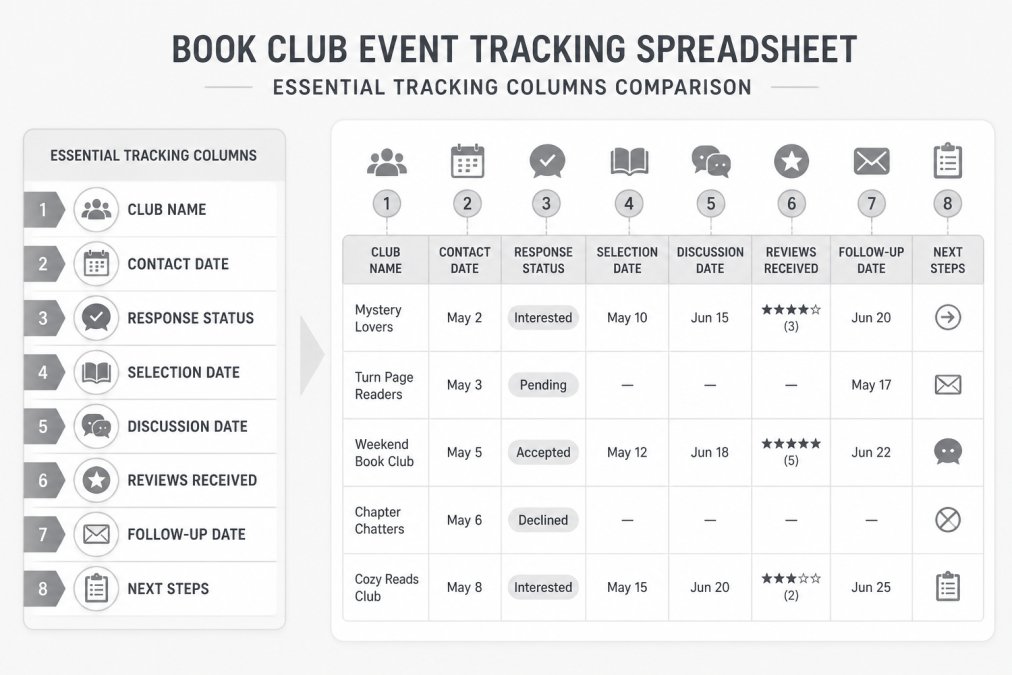
This structure lets you see the full lifecycle of each club relationship at a glance. You can quickly identify which clubs are responding, which are stalled, and which have moved to the next stage.
Using formulas to spot patterns
Once you have data in your spreadsheet, simple formulas help you see what's working. You don't need advanced skills, just basic counting and averaging.
Try these formulas:
- Count responses:
=COUNTIF(Response Status column, "Selected")tells you how many clubs have chosen your book - Calculate response rate: Divide total responses by total outreach attempts to see what percentage of clubs reply
- Average time to response: Subtract contact date from response date to see how long clubs typically take to reply
- Track review conversion: Count how many selections actually turned into reviews
These numbers answer real questions: Are you getting faster responses over time? Are certain contact methods more effective? Do clubs that receive discussion questions leave more reviews?
Creating Author Book Club Discussion Questions That Drive Engagement
Discussion questions are one of the most effective tools for deepening reader engagement.
Good discussion questions go beyond surface-level plot points. They invite readers to think about themes, characters, and how the story relates to their own lives. They create conversations, not quizzes.
Here's what makes discussion questions work:
- Ask about character motivations: "Why did [character] make that choice? What would you have done differently?"
- Explore themes: "How does the book handle [theme]? Did it change how you think about it?"
- Connect to readers' lives: "Have you experienced something similar to what [character] faced?"
- Invite personal reflection: "Which scene stayed with you most? Why?"
- Create debate: "Did you agree with how the story ended? What would you change?"
Most clubs appreciate 8-12 discussion questions. That's enough to spark conversation without overwhelming them. Include a mix of easier questions (to get people talking) and deeper ones (to sustain discussion).
When you send discussion questions to a club, include a note explaining why you created them. Something like: "I wrote these questions to help your group explore the themes that matter most in the story.
Track how many clubs use your discussion questions and whether those clubs leave more reviews. This metric directly shows whether your materials help you track book club engagement and drive results.
Writing a Book Club Follow-Up Email Template That Gets Responses
Follow-up emails are where many authors lose momentum. After a club selects your book, a well-timed follow-up keeps the relationship warm and reminds them you're invested in their experience.
Here's a template you can adapt:
Subject: Discussion Questions for [Book Title]
Hi [Club Name],
I'm excited that you've chosen [Book Title] for your upcoming discussion! I wanted to reach out with a few things that might enhance your club's experience.
I've created a set of discussion questions tailored to the themes in the book.
I'd also love to hear what your members think.
If your club is interested, I'm happy to join your discussion virtually or answer any questions your members have about the book or my writing process.
Looking forward to hearing how your discussion goes!
Best, [Your Name]
Send this email about 2-3 weeks before the club's discussion date. This timing gives them enough notice without feeling too early.
Track which follow-up emails get responses and which don't. Small changes in subject line, tone, or timing can significantly affect your response rate. If one version gets 40% responses and another gets 20%, that's your signal to repeat what worked.
Connecting Engagement to Real Results: Sales, Reviews, and Reader Growth
Tracking engagement metrics is only useful if you can connect them to actual business results. The goal isn't to have a pretty spreadsheet, it's to build a reader community that translates into sales, reviews, and long-term support.
Here's how to measure real impact:
Reviews and ratings: Track how many reviews you receive from each book club's discussion. Compare clubs that received discussion questions versus those that didn't. Note which platforms generate the most reviews (Amazon, Goodreads, local bookstore sites). This shows which engagement tactics actually move readers to review.
Sales velocity: Monitor whether sales increase after a club selection. You might see a spike during the discussion period and another spike after reviews post.
Reader growth: Count new email subscribers, social media followers, or newsletter sign-ups that come from book club exposure. Ask new readers where they heard about your book so you can attribute growth to specific clubs.
Repeat engagement: Some clubs will want to stay in touch after discussing your book. Track which ones express interest in future books or author events. These are your most valuable relationships.
The connection between engagement and results isn't always immediate. A club might discuss your book in month one but leave reviews in month two. Sales might spike weeks after a discussion as word spreads.
Organizing Your Book Club Outreach and Follow-Ups
Without a system for organizing outreach, it's easy to lose track of which clubs you've contacted, who's responded, and what you promised them.
Here's a simple workflow:
Step 1: Research and list, Find clubs that match your book's genre and audience. Create a list with their names, contact info, and any notes about their preferences.
Step 2: Send outreach, Write personalized emails (not generic templates) that show you know the club.
Step 3: Track responses, As clubs reply, update your spreadsheet immediately. Note whether they're interested, declined, or need more information.
Step 5: Schedule follow-up, Set a reminder to follow up 2-3 weeks before their discussion date. This keeps your book top-of-mind without being annoying.
Step 6: After discussion, Send a thank-you email and ask if they'd be willing to share reviews or feedback.
Step 7: Review and adjust, Every month, review your spreadsheet. Which steps are working? Where are clubs dropping off?
Many authors find that managing this process alone becomes overwhelming. This is where tools like ReaderReach help.
Frequently Asked Questions
How can self-published authors track book club engagement without being pushy?
Use a simple spreadsheet to record contact dates, response dates, and event attendance without pressuring readers. Focus on tracking what actually happened (did they read your book, did they leave a review) rather than creating unnecessary follow-ups. A single thoughtful email after the event works better than multiple check-ins. Respect that book clubs operate on their own timeline and let your data show genuine interest patterns rather than manufactured urgency.
What metrics should authors use to measure book club interest?
Track response rate (how many clubs reply to your outreach), acceptance rate (how many agree to read your book), completion rate (how many actually hold the discussion), and review rate (how many members leave reviews afterward). Also measure indirect engagement: newsletter sign-ups from club members, social media follows, and repeat inquiries from the same geographic area. These metrics show which outreach messages work and which reader communities are most receptive to your genre.
How often should authors follow up with a book club after sending their book?
Send one follow-up email 2-3 weeks after the initial pitch if you haven't heard back. If they've agreed to read your book, check in once about a week before their scheduled discussion date. After the event, send a thank-you message within 48 hours. Beyond that, one additional message 4-6 weeks later asking for feedback is reasonable. More than that risks annoying readers. Let your spreadsheet show which clubs are responsive so you know when to invest in follow-ups.
What should a book club follow-up email template include?
Start with a specific reference to the club (mention their name and genre focus). Thank them for reading and hosting a discussion. Ask a genuine question about what resonated with members. Offer something useful: a downloadable discussion guide, author interview, or exclusive excerpt. Include a clear call to action (leave a review, share on social media, sign up for your newsletter). Keep it under 150 words. Your template should feel personal, not like a mass email sent to dozens of clubs.
Tracking book club engagement transforms your outreach from a guessing game into a measurable strategy. When you know which clubs respond, which discussions generate reviews, and which follow-ups convert to sales, you can repeat what works and adjust what doesn't. Start simple with a spreadsheet, track the metrics that matter, and let the data guide where you focus your energy next. Over time, this approach builds a sustainable reader community that supports your author career for years to come.