Table of Contents
- Why Independent Authors Need Dedicated Book Marketing
- How to Get Book Reviews: Building Credibility from Day One
- Book Club Outreach for Authors: Connecting with Engaged Readers
- Book Marketing Strategies for Independent Authors: A Practical Framework
- Book Launch Promotion Services: Making Your Release Count
- Evaluating Services: What to Look For and What to Avoid
- Taking Action: Your Next Steps
- Frequently Asked Questions
Last Updated: October 11, 2026
Why Independent Authors Need Dedicated Book Marketing
Getting your book into readers' hands is harder than ever, which is why book marketing services for independent authors have become essential tools. The market is flooded with new titles, algorithms shift constantly, and independent authors must compete for attention while managing everything themselves.
This is where book marketing services for independent authors become essential. The right support transforms your launch into a coordinated campaign that reaches engaged readers. Many independent authors know their book is good but struggle to connect it with readers who'd love it most.
The difference between steady sales and barely moving often comes down to strategy, not quality. Many authors invest months perfecting their manuscript but only weeks on marketing, that ratio is backwards.
How to Get Book Reviews: Building Credibility from Day One
Reviews build social proof and credibility, influencing how potential readers perceive your work. They signal momentum to algorithms and early readers.
The challenge is finding the right reviewers for your genre. Generic requests get deleted; personalized ones that show you understand what they read get opened.
Identify reviewers in your genre by checking acknowledgments in similar books, Goodreads, and book blogger communities. Craft messages that explain why they would care about your book.
Start building reviewer relationships months before launch. Send advance copies to a curated list with time to read and respond before your release date, giving you reviews live on day one.
Book Club Outreach for Authors: Connecting with Engaged Readers
Book clubs drive real reader engagement. A single selection can mean dozens of copies sold, genuine conversations about your work, and word-of-mouth advocacy for your next release.
Finding Genre-Matched Book Clubs
Most book clubs won't be right for your work. The work is matching your book to clubs whose members actually read what you write.
Start with Meetup.com, Facebook groups, and Goodreads communities. Filter by genre and activity level, seek clubs that meet regularly, finish selections, and have engaged members who discuss their reads.
Local book clubs at libraries, bookstores, and community centers have smaller reach but are more likely to host author events, building deeper reader connections.
Personalizing Your Outreach Approach
Generic outreach fails. Personalized messages mentioning specific books they selected and showing you understand their taste get opens and positive replies.
Offer value: a discussion guide, a Q&A session, or behind-the-scenes access. Make it easy for them to say yes.
Follow up once after two weeks. After that, move on.
Book Marketing Strategies for Independent Authors: A Practical Framework
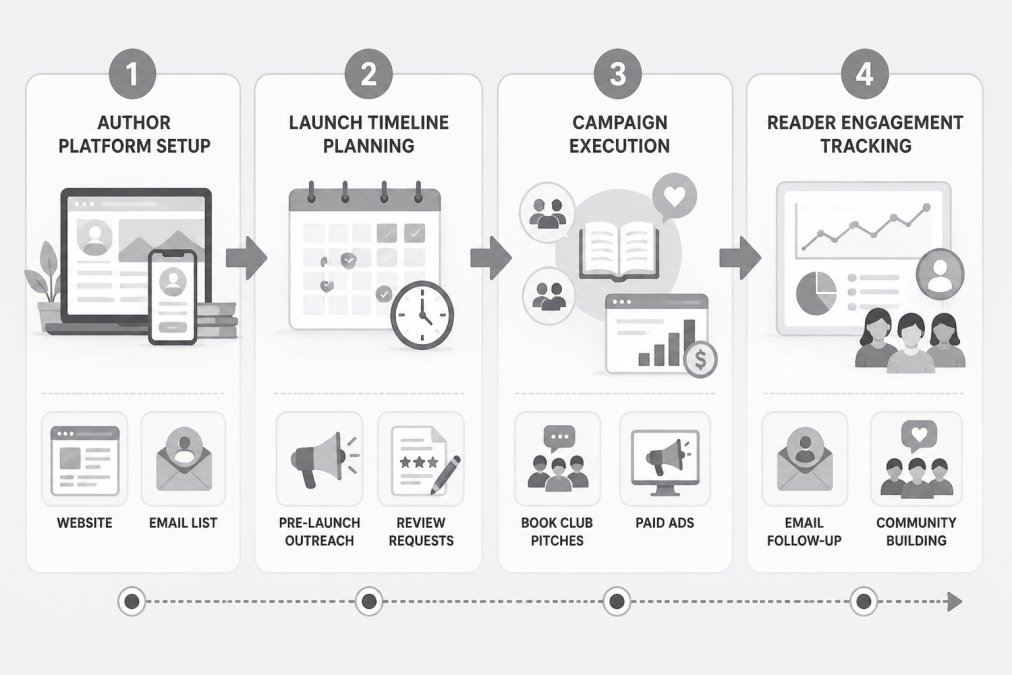
Effective book marketing strategies for independent authors are built on your author platform, follow a clear timeline, and treat your launch as a coordinated event.
Building Your Author Platform
Your author platform, website, email list, social media, is where readers find you and stay connected.
Build a simple, mobile-friendly website with links to your books, an email signup, and a brief bio explaining why readers should care about your writing.
Your email list is more valuable than social followers. Email is direct and unaffected by algorithm changes. Build your list from day one by offering a free chapter, exclusive story, or behind-the-scenes content in exchange for an email address.
Creating a Launch Timeline
Your launch starts six to eight weeks before release day. A coordinated timeline ensures each piece reinforces the others.
Send advance copies to reviewers eight weeks before launch. Six weeks out, start paid ads if using them. Four weeks before, intensify book club outreach. Two weeks before, launch pre-orders. Final week: email and social announcements. On launch day, capitalize on momentum you've already built.
Book Launch Promotion Services: Making Your Release Count
A book launch is your best visibility window. New releases get algorithmic boosts and active reader interest. Missing this window means fighting uphill for months.
Professional book launch promotion services coordinate pieces many authors manage alone. Understanding what you're paying for matters.
Types of Launch Services and What They Deliver
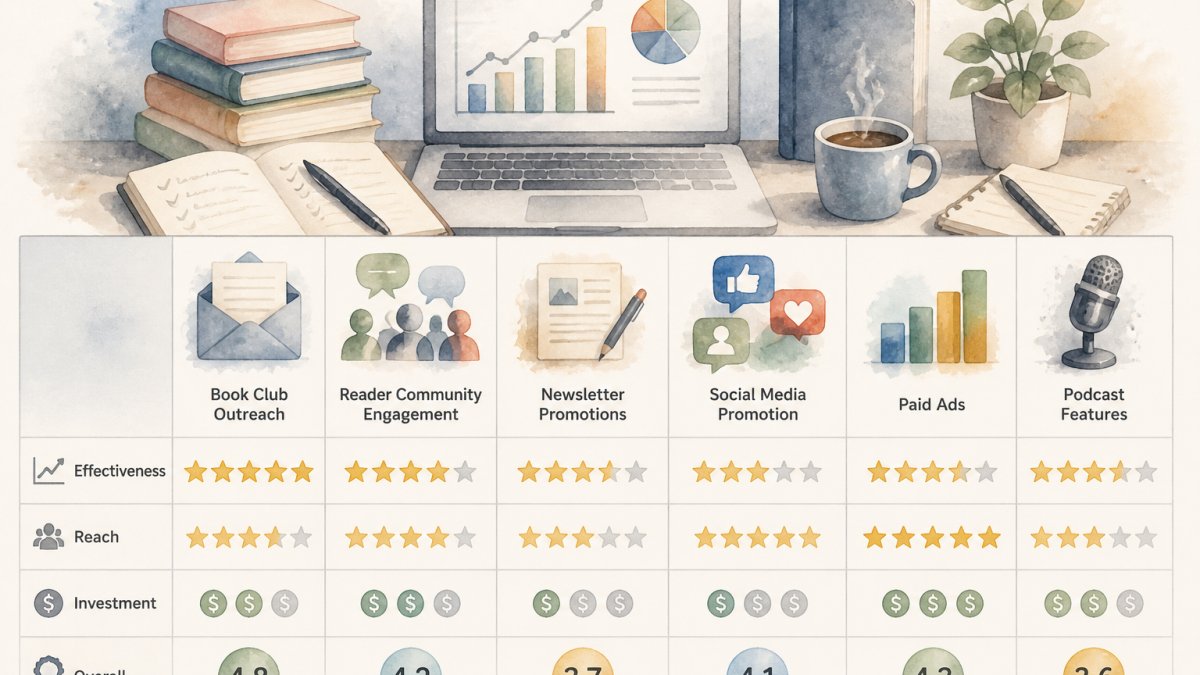
Common services include: Review coordination (identify reviewers, send copies, track responses); Book club outreach (pitch genre-matched clubs, coordinate Q&A); Paid ads (Amazon, Facebook, audience targeting); Email campaigns (list building, sequences); Social media (scheduling, graphics, announcements). Most combine two or three of these.
Matching Services to Your Situation
Match services to your bottleneck. Struggling with reviews? Use review coordination. Weak on reaching reader communities? Try book club outreach. Short on time? Use paid ad management. Genre matters, a service specializing in your genre understands where readers hang out and what messaging works. Your career stage also matters: first-time authors need different support than established authors.
What Launch Services Can and Cannot Do
No service guarantees bestseller status or specific sales. What they do is execute systematically: send to defined reviewers, pitch targeted clubs, run ads, build your email list. The value is consistency and execution, removing friction so you focus on writing. Legitimate services specify exactly what they'll do: how many reviewers, how many clubs, how many emails, what timeline.
Evaluating Services: What to Look For and What to Avoid
Not all services deliver real results. The difference comes down to specificity, transparency, and accountability.
Questions to Ask Before You Hire
Ask these questions: What exactly will you do? (Vague answers are red flags; demand specifics.) How many authors in my genre? (Specialization matters.) What results should I expect? (Realistic ranges: 10-30% reviewer response, 5-15% club interest.) How do you measure success? (Reviews posted? List growth? Sales?) Can I speak with other authors? (References matter.) What's included and what costs extra? (Understand bundling.) Contract length and cancellation policy? (Avoid long-term locks; 30-60 day trial is reasonable.)
Red Flags and What They Mean
"Guaranteed sales" or "guaranteed bestseller status." No legitimate service can guarantee this. Book sales depend on book quality, reader interest, timing, and market conditions, none of which a service controls.
Vague descriptions of what they'll do. "We'll market your book" or "We'll get you exposure" tells you nothing. You need to know the specific actions they'll take. If they won't explain their process in detail, they probably don't have one.
High-pressure sales tactics. Legitimate services don't need to pressure you. They let their results speak. If a service is pushing you to decide immediately, offering a "limited-time discount," or creating artificial urgency, that's a sign they're more focused on signing clients than delivering results.
Unwillingness to provide references. If a service won't connect you with other authors they've worked with, ask why. A service with good results should be proud to share them.
Extremely low prices. If a service is charging $200 to coordinate your entire book launch, they're either automating everything (which means generic, not personalized outreach) or they're not doing much work. Personalized outreach takes time. Reasonable pricing reflects that.
No way to track results. A service should provide you with reports: how many reviewers they contacted, how many responded, which book clubs they pitched, which ones showed interest. If they won't give you access to this data, you can't measure whether they're actually working.
What Legitimate Services Look Like
A service that's worth your money will:
- Explain their process in concrete terms
- Ask you questions about your book, genre, target reader, and goals before proposing a plan
- Provide realistic expectations about outcomes
- Give you references and encourage you to contact them
- Offer a clear contract with defined deliverables and timeline
- Provide regular updates and performance reports
- Be transparent about what they can and can't do
- Focus on your actual audience (readers in your genre) rather than vanity metrics
According to Author's Guild guidance on book marketing, independent authors should understand exactly what services they're paying for and what results to expect. This is your book and your investment. Due diligence protects both.
Measuring Results and Return on Investment
Before you pay for any service, establish how you'll measure success. Different services deliver different outcomes, and you need to know which ones matter for your goals.
Reviews and credibility: Track the number of reviews posted before and after your campaign, the average rating, and which platforms they appear on (Amazon, Goodreads, book blogs).
Email list growth: If the service includes list-building, measure how many new subscribers you gain and at what cost per subscriber.
Sales and revenue: Track your sales before, during, and after the campaign. Compare to your baseline. Did sales increase? By how much? For how long? This is the ultimate measure, but it's also influenced by factors outside the service's control (book quality, cover appeal, pricing).
Book club interest and events: Count how many book clubs express interest, how many actually select your book, and whether any lead to author visits or speaking opportunities. These create ongoing engagement beyond the initial sale.
Paid advertising performance: If the service manages ads, ask for weekly reports on impressions, clicks, conversions, and return on ad spend (ROAS).
A legitimate service should help you set these benchmarks upfront and report against them regularly. If they can't or won't, that's a problem.
Taking Action: Your Next Steps
Start with the foundation. If you don't have an author website, build one this week. If you don't have an email list, start one today. These cost nothing and take a few hours to set up. They're non-negotiable.
Next, identify ten book clubs in your genre. Research them. Find out who runs them, what their members read, when they meet. This is your target audience in concentrated form.
Then decide what level of support makes sense for your situation. Some authors handle outreach themselves once they know where to look. Others prefer to work with a service that manages the process. Both approaches work, the right one depends on your time, budget, and comfort level.
The authors who see the best results are the ones who treat marketing as an ongoing practice, not a one-time event. Your first book's launch is important. Your second book's marketing matters too. And your email list compounds in value with every release.
Getting your book in front of the right readers doesn't require a massive budget or connections you don't have. It requires strategy, consistency, and the right support system. ReaderReach specializes in connecting independent authors with book clubs and engaged reader communities through genre-matched outreach campaigns.
Frequently Asked Questions
How can independent authors get more reviews for their books?
Build relationships with book clubs and reader communities who are genuinely interested in your genre. Provide advance copies to engaged readers willing to review. Make requesting reviews straightforward, include a direct link in your book's back matter or author website. Follow up personally with readers who've finished your book. Services that specialize in book club outreach for authors can systematize this process, connecting you with multiple reader groups at once.
What should independent authors look for in a book marketing service?
Look for services that understand your specific genre and target audience. Ask how they measure success, whether through review counts, reader engagement, or sales. Verify they have experience connecting authors with book clubs and reader communities. Check that they offer transparent communication about campaign progress. Avoid services making unrealistic promises or charging upfront fees without clear deliverables. Request references from other authors they've worked with.
How long does a book launch promotion campaign typically take to show results?
Most book launch promotion services recommend planning 3-6 months before your release date. Initial outreach to book clubs and reader communities can generate early reviews and interest within 4-8 weeks. Building momentum through reader engagement, events, and podcast interviews takes ongoing effort beyond launch day. Results compound over time, your first month may generate modest interest, but sustained campaigns often see stronger engagement in months two and three as word-of-mouth spreads.
Are book promotion services worth it for indie authors on a tight budget?
This depends on your goals and available time. If you have limited hours to dedicate to outreach, a managed service can save significant time by handling research, personalization, and follow-ups. If you're willing to invest time learning book club outreach yourself, you can reduce costs. Consider your book's genre and target audience, services work best for genres with active book club communities. Start by clarifying what success looks like for you: more reviews, reader engagement, event opportunities, or sales growth.