Table of Contents
- Strategy 1: Build Your Author Platform and Connect With Readers Early
- Strategy 2: Create a Debut Novel Launch Plan With Timeline and Milestones
- Strategy 3: Run Book Club Outreach for Authors and Secure Reader Engagement
- Strategy 4: How to Get More Reviews for My Book and Build Social Proof
- Strategy 5: Use Paid Advertising and Social Media to Reach Your Target Audience
- Measuring Campaign Performance and Planning Beyond Your First Book
- Frequently Asked Questions
Last Updated: October 5, 2026
Strategy 1: Build Your Author Platform and Connect With Readers Early
Your author platform is where readers find you and stay engaged. Start building it months before launch.
Pick one primary channel where your ideal readers actually spend time, juggling five accounts will burn you out.
For fiction authors, consider:
- TikTok or Instagram if your readers skew younger and visual
- BookTok specifically if you write young adult or romance
- Newsletter if you want direct, unfiltered connection with engaged readers
The goal isn't viral fame, it's a group of people who care about your work.
Start sharing your process now, your writing journey, what inspired your book, or recommendations you love.
Strategy 2: Create a Debut Novel Launch Plan With Timeline and Milestones
A launch plan turns your release from a one-day event into a sustained campaign, so you're not scrambling at the last minute.
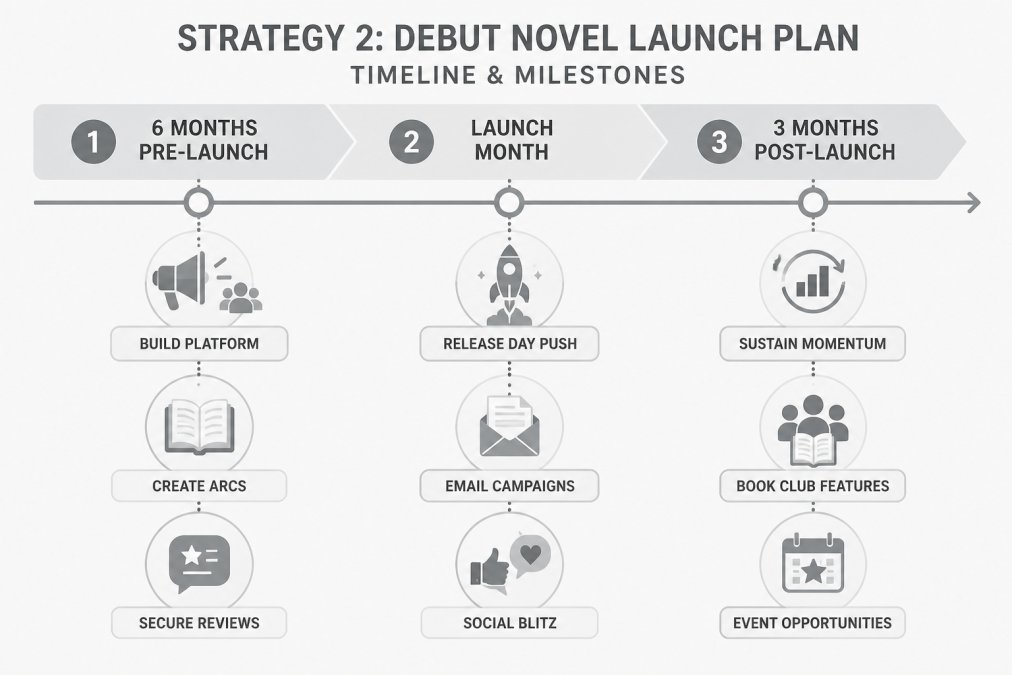
Your launch plan should span six months: three before your release and three after, giving you time to build anticipation, launch, and sustain interest.
Pre-launch phase (3-6 months before)
Start by securing advance reader copies (ARCs), early versions you send to readers, reviewers, and book bloggers before release.
Send ARCs 8-12 weeks before release so readers have time to finish and post reviews.
Build your email list now. Offer a free short story, character guide, or exclusive content in exchange for signups.
Create pre-order links on major retailers, pre-orders signal demand to algorithms and boost launch-day visibility.
Launch phase and post-launch momentum
Launch day matters, but it's not the finish line. Plan for the weeks around it:
- Week of launch: Send emails to your list, post on social media daily, reach out to book clubs and reviewers
- Weeks 2-3: Continue engagement, share reader reviews and testimonials, run any paid ads
- Months 2-3 post-launch: Shift focus to longer-term engagement, book club features, podcast interviews, reader events
Strategy 3: Run Book Club Outreach for Authors and Secure Reader Engagement
Book clubs are where real reader engagement happens. One selection reaches dozens of readers who then talk to each other, one of the few channels where a debut author competes with a bestseller on equal footing.
Why book clubs matter more for fiction than almost any other channel
Fiction lives or dies on word-of-mouth, and book clubs are word-of-mouth with a schedule. That conversation does three things:
- It creates sustained engagement. Readers don't just buy your book, they discuss it and remember it. Club members often become your most loyal readers and recommend your work.
- It generates reviews. Members post on Goodreads, Amazon, and social media, boosting your book's credibility and visibility after launch.
- It opens the door to author visits. Many clubs invite authors to join meetings in person or by video, deepening reader connection far more memorably than a social post.
Find clubs that actually read your genre
Start with genre-matched groups. Search Facebook, Goodreads, and community sites for clubs that read fiction like yours, don't email random clubs.
A few places to look:
- Goodreads groups: Many are organized by genre, trope, or region. Read recent discussion threads before reaching out.
- Facebook groups: Search for terms like "[your genre] book club" or "[your city] readers." Local clubs are often overlooked and more likely to say yes to a debut author.
- Library-run clubs: Public libraries often host genre-specific clubs and are used to featuring new authors.
Pitch like a reader, not a marketer
A generic email gets deleted. A message showing you've read their past selections and understand what they love gets responses.
A simple structure that works:
- Name the group and a recent book they read. This proves you did your homework.
- Explain in one sentence why your book fits their taste. Reference a trope, theme, or comparable title they've enjoyed.
- Offer something concrete. A free copy of your book, a chance to host you for a virtual author chat, or exclusive content like a discussion guide or deleted scene.
- Make the ask small. "Would you consider it for an upcoming month?" is easier to say yes to than "Will you feature my book?"
Make it easy for them to say yes
Book club organizers are busy volunteers. Remove friction and they're more likely to pick your book.
- Provide a discussion guide. Ten to fifteen questions about themes, characters, and endings. This is one of the most underused tools a debut author has.
- Offer a virtual visit. A thirty-minute video call is easy for you and a genuine event for them.
- Send physical copies if you can. Paperbacks get passed around. Ebooks get forgotten.
Follow up without being pushy
Most clubs won't respond to the first email, that's normal. One polite follow-up two weeks later, referencing your original note and adding a new detail, often gets a reply. After that, move on.
Strategy 4: How to Get More Reviews for My Book and Build Social Proof
Reviews are your book's credibility. Readers check them before buying, and more reviews increase sales.
Request reviews strategically with a book review request email template
Timing matters. Ask right after readers finish your book. If you give away ARCs, include a note asking them to post reviews on launch day.
Here's a template you can adapt:
Hi [Reader Name],
I'd love to know what you thought of [Book Title]. If you enjoyed it, would you consider posting a review on Amazon, Goodreads, or your favorite book site? Even a few sentences helps other readers find the book.
You can post here: [link to book on retailer]
Thanks so much, [Your Name]
Keep it short. Readers are busy. A quick, genuine ask works better than a long pitch.
Work with advance reader copies and book bloggers
Book bloggers reach thousands of readers across their blogs, social media, and Goodreads.
Send ARCs to book bloggers in your genre, and personalize your pitch. Show you've read their reviews and know what they like.
Offer them flexibility. Some bloggers prefer ebooks, others want paperbacks. Some want to feature your book on a specific date.
Strategy 5: Use Paid Advertising and Social Media to Reach Your Target Audience
Organic reach has limits. Paid ads reach readers who haven't found you yet, but for a debut author the goal isn't to outspend anyone, it's to spend deliberately, learn fast, and stop paying for what doesn't work.
Match your budget to your goal, not your hopes
Most debut authors think in tiers rather than a single number. Three rough tiers are useful:
- Test tier: A very small daily amount, enough to gather data over one to two weeks. The point is learning which cover, blurb, and audience combination earns clicks, not making sales.
- Launch tier: A moderate daily amount concentrated around release week and the two weeks after, when reviews and word-of-mouth are freshest. This is when paid reach compounds with organic buzz.
- Sustain tier: A reduced daily amount running for months after launch, aimed at keeping your book visible to new readers in your genre.
If money is tight, paid ads are optional. A debut author with no ad budget can still get traction through book clubs, reviewers, and their email list. Ads amplify what's already working, they rarely rescue a book nobody is talking about.
Target readers by what they already love
Fiction targeting works differently from nonfiction. You're not chasing people who searched for a problem. You're finding readers who already love books like yours.
A practical approach:
- Comparable authors: Target readers who follow authors writing in your genre and subgenre. If your book sits next to theirs on a shelf, their readers are your readers.
- Comparable titles: Target readers who've engaged with books similar to yours in tone, trope, or theme.
- Tropes and subgenres: Romance, fantasy, thriller, and cozy mystery readers often self-identify by trope. "Enemies to lovers," "morally gray protagonist," or "small-town mystery" can be more useful targeting signals than broad genre labels.
Avoid broad targeting like "people who like books." It burns budget on readers who will never pick up your genre.
Measure the few numbers that actually tell you something
You don't need a dashboard, just four numbers in a simple spreadsheet:
- Click-through rate: Are people interested enough to click your ad? A low rate usually means the image or headline isn't landing.
- Cost per email signup: If your ad sends readers to a signup page, this tells you what a subscriber costs you. Compare it to the value of a reader who buys your next book.
- Cost per sale: For direct-to-retailer ads, this is the number that matters most. If it's higher than your royalty per book, the ad is losing money.
Give any campaign at least a week before judging it. Early numbers are noisy; look for a pattern, not a single good or bad day.
Pair ads with your email list so the spend keeps paying off
Paid ads can bring new readers to your email signup page. Offer something genuinely useful: a free prequel short story, character guide, map, or exclusive scene.
A reader on your email list is worth far more than a one-time sale. They've chosen to hear from you, and when your second book comes out you can reach them for free.
Measuring Campaign Performance and Planning Beyond Your First Book
Your first book is the foundation. What you learn shapes your strategy for book two and beyond.
Track the metrics that matter
Focus on what moves your business forward:
- Email signups: How many new subscribers?
- Book sales: Which channels drove the most buyers?
- Reviews: How many, and on which platforms?
A simple spreadsheet tracking these numbers over time shows you what's working.
Build momentum for your second book
Your first book's readers become your audience for your second.
Start building that list now, even if book two is months away.
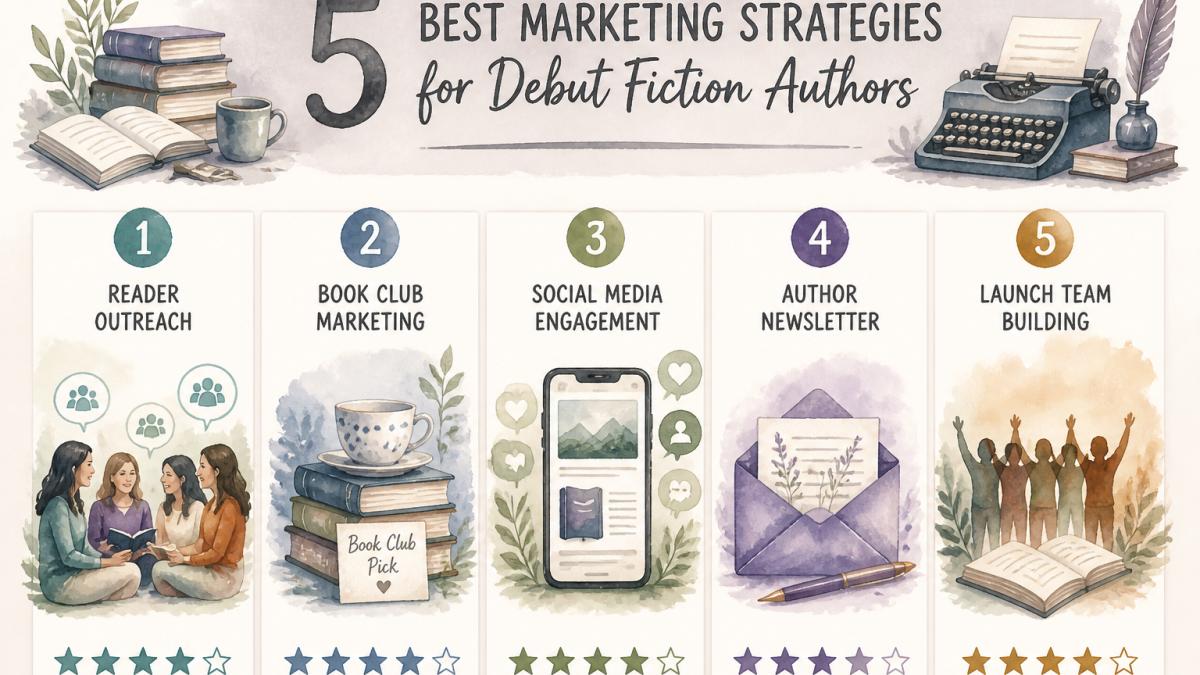
Getting your debut novel into readers' hands requires the 5 best marketing strategies for debut fiction authors: strategy, consistency, and genuine connection.
If you're managing all this outreach yourself, it's a lot.
Start with your platform, commit to your launch timeline, and prioritize book club outreach.
Frequently Asked Questions
When should a debut author start marketing their book?
Start building your author platform and audience at least 3-6 months before your book launches. Early marketing gives you time to grow your email list, establish credibility, and create pre-launch buzz. The earlier you begin, the more readers you'll have waiting when your book becomes available. Many successful debut authors begin their platform work even before their manuscript is finished.
How can I get more reviews for my debut novel?
Request reviews from advance reader copies (ARCs) at least 6-8 weeks before launch. Reach out to book bloggers and reviewers in your genre with a personalized book review request email. Ask your early readers for honest reviews on retail platforms. Work with book clubs, as members often leave reviews after reading. Consider a small giveaway to encourage reviews, and follow up politely with readers who've finished your book.
What is the best way to approach book club outreach for authors?
Research book clubs that match your genre and reader interests. Send personalized outreach messages that show you understand what they read and why your book fits their group. Offer value: a free copy, author Q&A, or virtual visit. Use a book review request email template tailored to each group rather than generic mass emails. Follow up professionally if you don't hear back, and build relationships beyond a single book selection.
Should I use paid advertising as a debut author on a tight budget?
Yes, but start small and test before spending heavily. Allocate a modest budget to reach readers interested in your genre. Track which channels deliver the best return, Amazon advertising, social media ads, or newsletter ads often work well for fiction. Measure results by monitoring click-through rates and conversions. Many debut authors find that combining organic outreach (book clubs, reviews) with small, strategic paid campaigns delivers the best results.