
Table of Contents
- Why Book Clubs Reject Books and What It Means
- Step 1: Take a Breath Before You Respond
- Step 2: Craft a Professional Book Club Rejection Email Response
- Step 3: How to Follow Up With a Book Club After Rejection
- Step 4: How to Find Book Clubs for Your Book and Improve Your Targeting
- Step 5: Learn From Rejection and Refine Your Pitch
- Step 6: Build Momentum With Other Opportunities
- Turn Rejection Into Your Launch Strategy
- Frequently Asked Questions
Last Updated: October 14, 2026
Why Book Clubs Reject Books and What It Means
Learning how to handle book club rejection stings, but it's a skill you can master. You've poured months into your manuscript, and a group that seemed like a perfect match passes.
Understanding why rejection happens helps you handle book club rejection without treating it as a verdict on your work. The ones who bounce back fastest treat rejection as data, not defeat.
Step 1: Take a Breath Before You Respond
Your first instinct after rejection might be to fire off a quick email or move on entirely.
Wait 24 hours before responding to anything, so you can process the disappointment and think clearly about your next move.
When you do respond, you're not trying to change their mind about this book. You're laying groundwork for future opportunities.
Use this time to think about what you learned. Did the rejection mention a reason?
Step 2: Craft a Professional Book Club Rejection Email Response
Your response email shows professionalism and grace. It takes five minutes to write, but it shapes how that book club remembers you.
What to include in your response
Start with gratitude.
Next, acknowledge their decision without argument. "I appreciate you taking the time to review my submission" works.
Then add a forward-looking statement showing you're thinking about the relationship, not just this one book: "I'd love to stay connected.
Close with warmth and your contact information. Keep it brief, two or three short paragraphs maximum.
What to avoid
Don't argue with their decision, ask for detailed feedback, suggest they made a mistake, or pitch a different book in the same email.
Avoid sounding bitter or disappointed, even if you feel that way. Stay professional and upbeat, like you're already thinking about the next opportunity.
Don't make promises you can't keep ("I'll definitely have my next book ready in three months"). Stick to what you know is true.
Step 3: How to Follow Up With a Book Club After Rejection
Rejection doesn't close the door permanently.
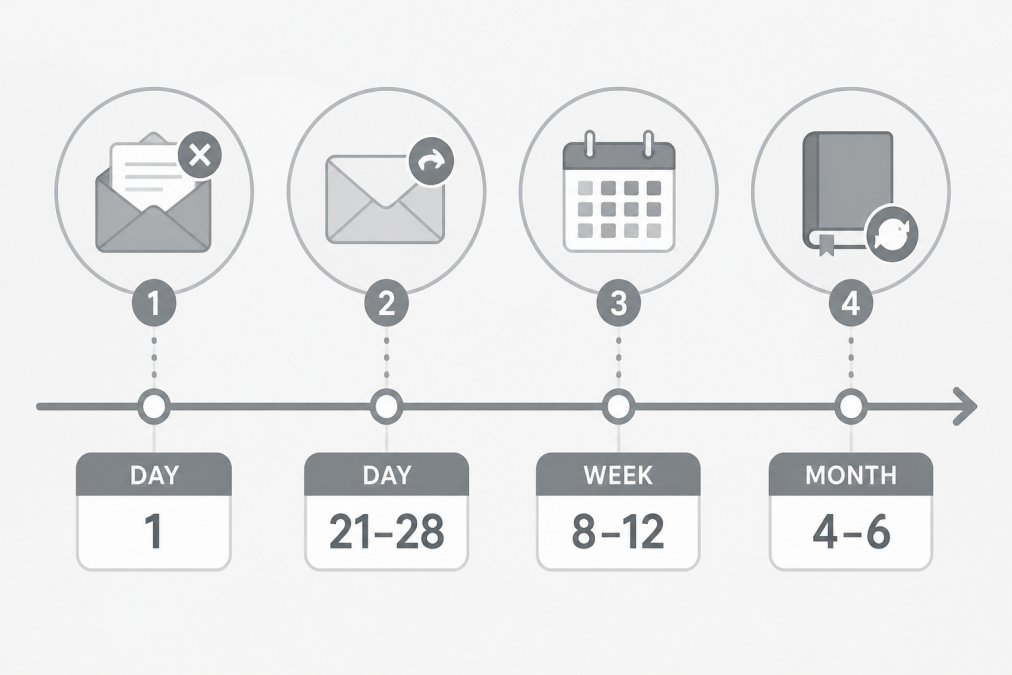
Timing matters. Wait at least three weeks before following up, this shows respect for their decision and gives you time to improve your approach.
When you do follow up, keep it brief.
This isn't about the book they rejected. It's about showing you're still active and professional.
After two rejections with no response, move on and respect their silence.
Step 4: How to Find Book Clubs for Your Book and Improve Your Targeting
The real work happens here. Better targeting means fewer rejections and more yeses, and it's a repeatable process you can run in an afternoon.
Build a master list of potential clubs
Cast a wide net first, then narrow down. Here's where to look:
- Goodreads Groups: Search for your genre plus "book club." Join the groups, read their recent discussion threads, and note which ones are active and which are ghost towns.
- Library websites: Many public libraries host book clubs and list their current and past selections. Check the events calendar or ask a librarian.
- Bookstore newsletters: Independent bookstores often run or promote clubs. Sign up for their emails and watch for club announcements.
- Facebook Groups: Search for "[your genre] book club" and "[your city] book club." Look at post frequency and member engagement.
Aim for 30-50 potential clubs, then narrow down.
Score each club against your fit criteria
Not all clubs are equal. Build a simple scoring sheet:
| Criteria | What to look for | Why it matters |
|---|---|---|
| Genre match | Has the club read at least one book in your genre in the past 18 months? | Genre mismatch is the #1 reason for rejection. |
| Activity level | Do they meet monthly or more? Are discussions recent? | Inactive clubs won't respond to pitches. |
| Size | 20-100 active members | Large enough to matter, small enough to be selective. |
| Author events | Have they hosted an author in the past year? | Clubs that host authors are more open to pitches. |
| Contact clarity | Is there a clear contact email or form? | If you can't find a contact, you can't pitch. |
Score each club 1-5 per criterion and add up the totals. Your top 10-15 become your priority outreach list; the rest go into a "maybe later" pile.
Prioritize your outreach in waves
Don't pitch everyone at once. Work in waves:
- Wave 1 (top 5 clubs): Personalize each pitch. Mention a specific book they've read that's similar to yours. Reference a recent discussion thread. Show you've done your homework.
- Wave 2 (next 10 clubs): Use a slightly more templated pitch, but still customize the first line and the genre reference.
- Wave 3 (remaining clubs): A shorter, more general pitch is fine here.
This lets you learn from early responses and adjust your pitch before contacting everyone.
Track everything in a simple spreadsheet
You can't improve what you don't measure. Set up a spreadsheet with these columns:
- Club name
- Contact person (if known)
- Email address
- Date pitched
- Pitch version (A, B, C)
After 20-30 pitches, patterns emerge: a weak subject line, clubs that are too large, a confusing genre description. The spreadsheet turns vague feelings into fixable problems.
A note on paid matching services
Some authors use paid matching services. They can save time, but quality varies widely. Before paying, ask for a sample of clubs they work with and check whether those clubs are active and genre-appropriate.
Step 5: Learn From Rejection and Refine Your Pitch
Every rejection is feedback if you know how to read it.
Look at the rejection message. If they gave a reason, take it seriously. "Our members prefer standalone novels" tells you something.
No response is also feedback: your subject line didn't work, your pitch was too long, or the book didn't catch their attention.
Adjust your pitch for the next round: shorter, stronger hook, leading with what makes your book different, not just what it's about.
Step 6: Build Momentum With Other Opportunities
While following up with book clubs, don't wait idle. Build momentum elsewhere, but measure and prioritize it.
Start with a simple priority matrix
Not all opportunities are equal. Sort them by effort and impact:
| Low effort | High effort | |
|---|---|---|
| High impact | Pitch 5 more book clubs this week | Arrange a local library reading |
| Low impact | Post a quote on social media | Cold-call a national podcast |
Spend most of your time in the top-left box, where small actions create outsized results. The bottom-right box is where authors burn out.
Free and low-cost actions that move the needle
- Pitch book bloggers in your genre. A thoughtful email to bloggers who review your genre can yield reviews. Those reviews become social proof you can show to book clubs.
- Offer to be a guest on podcasts. Small, niche podcasts are often looking for guests. A conversation reaches a highly targeted audience and gives you a clip you can share.
- Reach out to libraries. Many libraries have "book club in a bag" programs or author event series. A simple email to the adult services librarian can open doors.
- Write a guest article for a genre blog. A guest article on a topic your readers care about positions you as an expert and includes a link to your book.
Measure what's working
You don't need fancy analytics. Use these simple methods:
- Unique links: Create a different link for each outreach channel (e.g., yourwebsite.com/bookclub, yourwebsite.com/podcast). Use a free link shortener to track clicks.
- Promo codes: If you sell directly, offer a code like PODCAST10 and see how many people use it.
- Email sign-ups: Ask people to join your newsletter and note which channel they came from. Even a simple "How did you hear about me?" field works.
- Sales snapshots: Check your sales dashboard the day after a podcast or blog feature. Look for spikes.
After a month, you'll know which activities drive results. Double down on those and drop the rest.
When to consider paid promotion
Paid ads can work, but they're not the first step. Test them only after you have:
- A book page that converts well (clear description, strong cover, reviews)
- A way to track results (links or codes)
- A small budget you're comfortable losing while you learn
Start with a very small daily budget on one platform. Run it for two weeks. If you see a positive return, scale slowly. If not, stop.
A sustainable timeline
Don't try to do everything at once. Here's a simple rhythm:
- Week 1-2: Build your book club list and send Wave 1 pitches.
- Week 3-4: Pitch 5 book bloggers and 2 podcasts.
- Week 5-6: Follow up with book clubs and check your tracking sheet.
- Week 7-8: Write one guest article and contact 3 libraries.
- Ongoing: Repeat the highest-performing activities from your tracking data.
This pace is manageable alongside writing and gives each activity time to produce results.
Turn Rejection Into Your Launch Strategy
Rejection is part of book marketing, not a sign to stop, but a sign to refine.
Build a system: track which book clubs you've pitched, when, and how they responded.
This approach takes time. Each rejection teaches you something. Each yes builds your reader base.
ReaderReach provides a specialized outreach service designed to help independent authors connect with book clubs and reader communities.
Frequently Asked Questions
How should I respond when a book club rejects my book?
Stay professional and gracious. Thank them for considering your work, express genuine interest in their group, and keep the door open for future opportunities. Avoid defensive language or asking why they rejected you immediately. A simple, warm response shows maturity and leaves a positive impression that could lead to future collaboration or referrals to other clubs.
When should I follow up after a book club says no?
Wait an appropriate amount of time before your first follow-up to give them space. A brief, friendly message checking in is appropriate. If there's no response, a second follow-up may be reasonable. After that, respect their decision and move forward. Persistent contact after multiple rejections can damage your reputation with that group.
Why might a book club decline an author's book?
Common reasons include genre mismatch, reading schedule conflicts, budget constraints, or simply having a full lineup. Some clubs focus on established authors or specific themes. Others may have already chosen similar titles. Understanding these reasons helps you target better prospects. Rather than taking it personally, use rejections to refine your research and identify clubs that genuinely align with your book's genre and audience.
How do I find book clubs that are a good fit for my book?
Research clubs that actively read your genre and welcome author participation. Look for groups on Goodreads, local library websites, independent bookstores, and social media communities. Check their past selections to confirm alignment with your book's themes and tone. Personalized outreach to clubs that genuinely match your work dramatically increases acceptance rates compared to mass pitching.
Book club rejection hurts in the moment, but it's a normal part of author marketing. The key is treating it as information, not as a final verdict. Respond professionally, follow up strategically, and keep pitching to better-targeted clubs. When you combine this with other reader engagement efforts, rejection becomes just one step in a larger strategy that eventually leads to real reader connections and book sales.