Table of Contents
- What Is a Book Club Outreach Campaign?
- Why Book Clubs Matter to Authors and Readers
- How to Contact Book Clubs as an Author
- A Book Club Outreach Email Template That Gets Replies
- Author Book Club Visit Ideas for In-Person and Virtual Meetings
- How to Get Book Reviews From Book Clubs
- Measuring Your Campaign and Spotting Scam Warning Signs
- Frequently Asked Questions
Last Updated: October 17, 2026
What Is a Book Club Outreach Campaign?
A book club outreach campaign is a planned, repeatable effort to connect your book with reading groups through researched, personalized contact and structured follow-up.
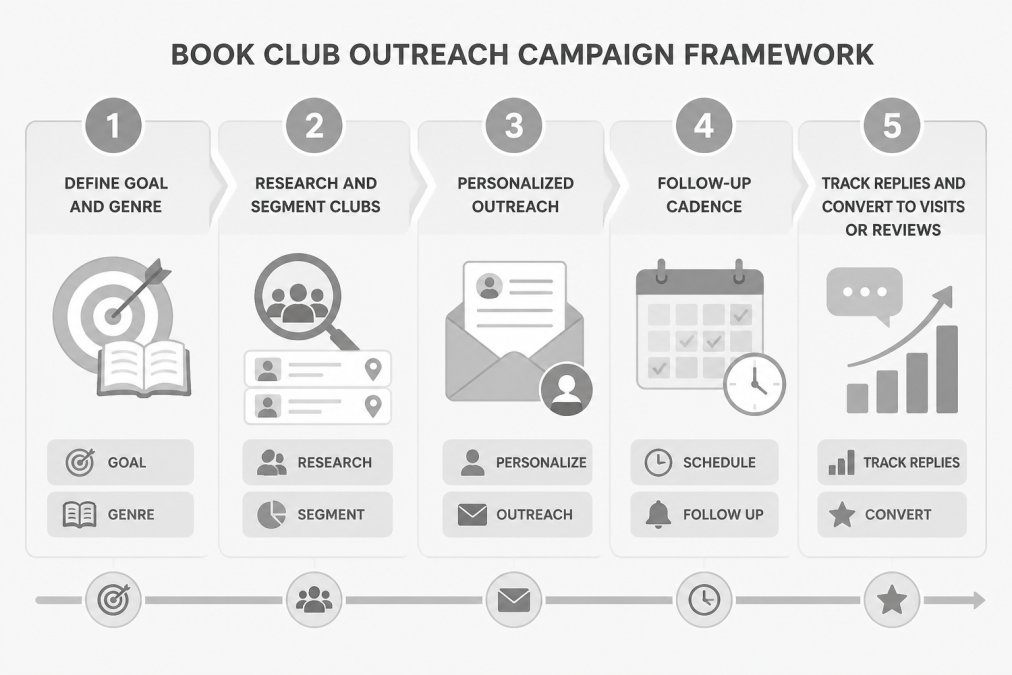
At ReaderReach, we define a campaign by its framework, not its volume.
How a Campaign Differs From One-Off Pitching
One-off pitching is a single email to whoever you can find, sent once, with no record of what happened next. A campaign has a target list, a message sequence, a follow-up rhythm, and a scoreboard.
A one-off pitch dies in an inbox. A campaign keeps a club in your pipeline until they answer, decline, or book something. Below, we'll show you how to build each stage so the effort compounds.
Why Book Clubs Matter to Authors and Readers
A single book club selection puts your title in front of a room of engaged readers at once, and those readers talk.
For readers, clubs turn a solitary act into a shared one. Members compare perspectives, argue about endings, and leave with a longer reading list.
The catch most guides skip: clubs are protective of their meeting time. They want a book worth discussing and an author who respects their schedule.
How to Contact Book Clubs as an Author
Start with research, not a template. The authors who get replies show up knowing the club's genre, recent reads, and organizer by name. Contacting book clubs works best as a slow, targeted process rather than a mass send, and the biggest upgrade you can make is to segment prospects before you write a word.
Segmenting Clubs Before You Pitch
Not every reading group is a fit, and treating them all the same is why most pitches die. Sort prospects along five dimensions:
- Genre focus. A thriller club is a poor fit for a cozy romance, no matter how good the pitch. Note whether the group reads broadly or sticks to one lane.
- Location and format. In-person, virtual, or hybrid changes what you can offer. A virtual club can say yes to an author across the country; a local group may welcome an in-person visit.
- Size. A six-person living-room club and a sixty-person library group need different asks. Small groups value intimacy; large groups value structure and a clear program.
Once those columns are filled, rank each prospect as hot, warm, or cold. Hot means genre match, active schedule, and a reachable organizer. Warm means two of the three. Cold means one or none. Work the hot list first and spend your best energy where replies are most likely.
Finding Genre-Matched Groups
Look where your readers already gather. Libraries host registered reading groups, independent bookstores run their own circles, and community boards and social platforms carry local listings.
Build a simple prospect sheet with columns for club name, genre focus, meeting format, group size, organizer contact, last read, and source. That sheet becomes your campaign's backbone and your record of who to follow up with.
Researching the Organizer Before You Write
Read the club's public presence before you send anything. Note their last three picks, whether they meet virtually or in person, and how they prefer to be contacted.
Personalization is not flattery. It is proof you did five minutes of homework. Mention a recent selection you admire or a theme your book shares, and you move from stranger to potential guest.
Prioritizing Prospects Instead of Blasting Everyone
Authors who get consistent yeses use a tiered list. Tier one gets a fully personalized pitch and a tailored offer. Tier two gets a shorter personalized note with a standard offer. Tier three gets a brief introduction and an invitation to opt in to future news.
Revisit the list every few weeks. Clubs change organizers, switch formats, and rotate themes. A cold prospect in spring may be a hot one by fall.
A Book Club Outreach Email Template That Gets Replies
The best book club outreach email template is short, specific, and easy to say yes to. Organizers are busy volunteers, so lead with why your book fits their group, offer something concrete, and ask one clear question.
Here is a template you can adapt:
Subject: A [genre] pick for [Club Name]'s next read
Hi [Organizer Name],
I noticed [Club Name] recently read [recent title], and I thought my novel, [Book Title], might fit your group's taste for [theme/genre]. It follows [one-line hook].
I'd love to offer your members a free discussion guide and, if it's useful, a short virtual Q&A with me at your meeting. No pressure either way.
Would a quick look at the first chapter be helpful? I'm happy to send it.
Warmly, [Your Name]
Keep it under 150 words. One ask, one offer, one easy next step.
Follow-Up Cadence Without the Pestering
Most replies come after the first email, not from it. Plan three touches: the initial message, a gentle nudge about a week later, and a final check-in two weeks after that. Then stop.
Each follow-up should add something, not repeat the first. Share the discussion guide, mention a recent review, or offer a flexible date. When someone declines, thank them and ask if a future title might fit.
Author Book Club Visit Ideas for In-Person and Virtual Meetings
An author visit turns a good read into a memorable event. The strongest author book club visit ideas give the group something they cannot get from the page: your voice, your process, and a chance to ask questions directly.
- The backstory session: share how one scene or character came to life, then open the floor.
- The Q&A hour: let members drive the conversation with their own questions and theories.
- The virtual drop-in: join by video for 20 minutes when distance or schedules get in the way.
Virtual events remove geography as a barrier and often boost attendance for clubs spread across a region. Whichever format you choose, send discussion questions ahead so members arrive ready to talk.
How to Get Book Reviews From Book Clubs
Reviews come from genuine enthusiasm, not a request tacked onto the end of a meeting. The most reliable path to book reviews from book clubs is to earn the group's goodwill first, then make leaving a review effortless.
After a visit or a strong discussion, thank the organizer and mention that honest reviews help independent authors reach new readers. Point members to where reviews matter most, and never offer anything in exchange for a positive rating.
Reader feedback gathered during a meeting is gold for future pitches too. Ethical outreach means respecting a no, disclosing any free copies you provide, and following the review policies of the platforms you use, such as Amazon's customer review guidelines.
Measuring Your Campaign and Spotting Scam Warning Signs
A campaign you cannot measure is just hopeful emailing. Track a handful of numbers so you know what is working, and pair that with a realistic timeline and resource plan so the effort fits your actual week.
The Numbers That Matter
Track emails sent, reply rate, visits booked, reviews received, and event attendance. Response rate tells you whether your messaging fits; conversion to visits tells you whether your offer is compelling. Review these weekly and adjust the template, not the whole strategy.
| What to track | Why it matters | How often |
|---|---|---|
| Emails sent | Shows campaign volume and pacing | Weekly |
| Reply rate | Signals whether your pitch fits | Weekly |
| Visits booked | Measures real interest | Per campaign |
| Reviews received | Tracks lasting reader engagement | Monthly |
| Event attendance | Gauges community reach | Per event |
Read the numbers as a story, not a scoreboard. A low reply rate with high visit conversion means your list is well targeted but your subject lines are weak.
A Practical Campaign Timeline
Most authors see the best return from a focused campaign run over six to eight weeks rather than a single burst. A workable rhythm:
- Weeks one and two: build and segment the prospect list, research organizers, and draft the pitch.
- Weeks three and four: send the first wave of personalized outreach and log every reply.
- Weeks five and six: send follow-ups, book visits, and send discussion guides to confirmed clubs.
After the campaign, spend a week reviewing what worked and updating your prospect sheet before the next round.
Scoping the Effort to Your Resources
You do not need a big team to run a real campaign. Match the plan to the time you actually have:
- Low-effort plan: a hand-built list of twenty to thirty hot prospects, one personalized template, and a three-touch follow-up. This fits a few hours a week and is enough to land a handful of conversations.
- Medium-effort plan: a segmented list of fifty to one hundred clubs, two pitch variants by genre, a shared tracking sheet, and scheduled follow-ups. This is the sweet spot for most authors launching a book.
- Higher-effort plan: a larger segmented list, dedicated outreach identity, daily follow-up triage, and coordinated virtual events. This is where a helper or a service earns its keep.
A focused campaign run over several weeks, with a clear list and a steady follow-up rhythm, beats a burst of untracked emails.
Spotting Scam Warning Signs
Just as important as measuring results is protecting yourself. Legitimate clubs and organizers do not demand upfront fees to "feature" your book, ask for sensitive personal or financial details by email, or pressure you into paying for guaranteed reviews. If an offer promises placement in exchange for payment to an unknown third party, treat it as a red flag and verify before you engage.
ReaderReach handles the research, daily outreach, and follow-up triage through its Campaign Desk, so authors can focus on the conversations that actually convert. You can check current plans on the ReaderReach pricing page.
Frequently Asked Questions
What is a book club outreach campaign?
It is a planned, ongoing effort to introduce your book to reading groups that already match your genre. Rather than sending one mass email, you research clubs, segment them by interest, send personalized messages, follow up on a schedule, and track replies. The aim is to turn a group read into conversation, reviews, and sometimes an author visit. ReaderReach runs this as a managed service, handling the research, outreach, and follow-up so authors can focus on writing.
How do authors find book clubs that match their books?
Start with genre. A thriller writer should target mystery and suspense groups, not general fiction circles. Look at library reading groups, independent bookshop clubs, online communities, and local meetups. Check what each group has read recently and whether your themes fit. Build a simple list with the organizer's name, contact route, and recent picks. ReaderReach does this genre-matched contact research for authors, which saves hours of manual searching each week.
How long does a book club outreach campaign take?
Expect a few weeks before replies start arriving, and a couple of months to build steady momentum. Reading groups often plan their selections a season ahead, so a campaign timed to a launch should begin well before publication. Follow-up matters as much as the first email; many organizers reply on the second or third touch. A managed campaign keeps that cadence running daily, which is hard to sustain alone alongside writing and promotion.
How can book clubs help authors get reviews?
A group read puts your book in front of ten or more readers at once, and some of them will leave reviews if you make it easy. Include a short note in the discussion guide with a direct link to the review page, and ask the organizer to share it after the meeting. Never pressure members or offer incentives for reviews, since that breaks retailer rules. Genuine feedback from a group discussion tends to be specific and useful, which helps other readers decide.
What should authors do after a book club responds?
Reply quickly and warmly, confirm what the group needs, and send your discussion guide and reading materials. Offer a visit, virtual or in person, if the timing works. After the meeting, thank the organizer and ask whether members would consider leaving reviews. Log the contact so you can return when your next book launches. That follow-through turns a single selection into a lasting relationship with a reader community.