Table of Contents
- Why Self-Published Authors Need a Marketing Plan
- Building Your Author Platform and Reader Base
- Creating a Book Marketing Timeline That Works
- How to Get More Book Reviews and Reader Engagement
- Author Marketing Plan Examples by Genre and Goal
- Book Marketing Plan Template and Action Steps
- Marketing Your Book Without Breaking the Bank
- Measuring What Works and Adjusting Your Strategy
- Frequently Asked Questions
Last Updated: October 12, 2026
Why Self-Published Authors Need a Marketing Plan
Most self-published authors treat marketing like an afterthought. They finish their book, upload it to a retailer, and hope readers find it. That approach rarely works.
The books that gain traction share one thing in common. They have a strategy.
Without a plan, you're making marketing decisions in a vacuum. You might miss obvious opportunities like book clubs or reader communities that could champion your work.
A solid marketing plan solves this.
Building Your Author Platform and Reader Base
Your author platform is the foundation everything else rests on. It's how readers discover you, stay connected to you, and ultimately buy your next book. Without one, every marketing effort feels like starting from zero.
Author website and email list essentials
An author website is non-negotiable. It's the one place you control completely. Social media platforms can change their algorithms, restrict your reach, or disappear. Your website stays yours.
Your email list is even more valuable than your website. When someone joins your list, you have direct access to them.
Start collecting emails immediately. Offer something readers actually want: a free chapter, a bonus story, a downloadable guide related to your book's topic.
Social media and content strategy
Social media works best when it's consistent and authentic. Pick one or two platforms where your readers actually spend time. Fiction readers might be on Instagram or TikTok.
Content strategy means sharing things your readers care about, not just promoting your book.
The goal is to build an audience around you, not just your book. When people follow you because they find your perspective valuable, they'll buy your work when it's ready.
Creating a Book Marketing Timeline That Works
Timing matters in book marketing. Launch your promotion too early and momentum fades before release day. Start too late and readers don't know your book exists. A structured timeline keeps you on track and ensures nothing falls through the cracks.
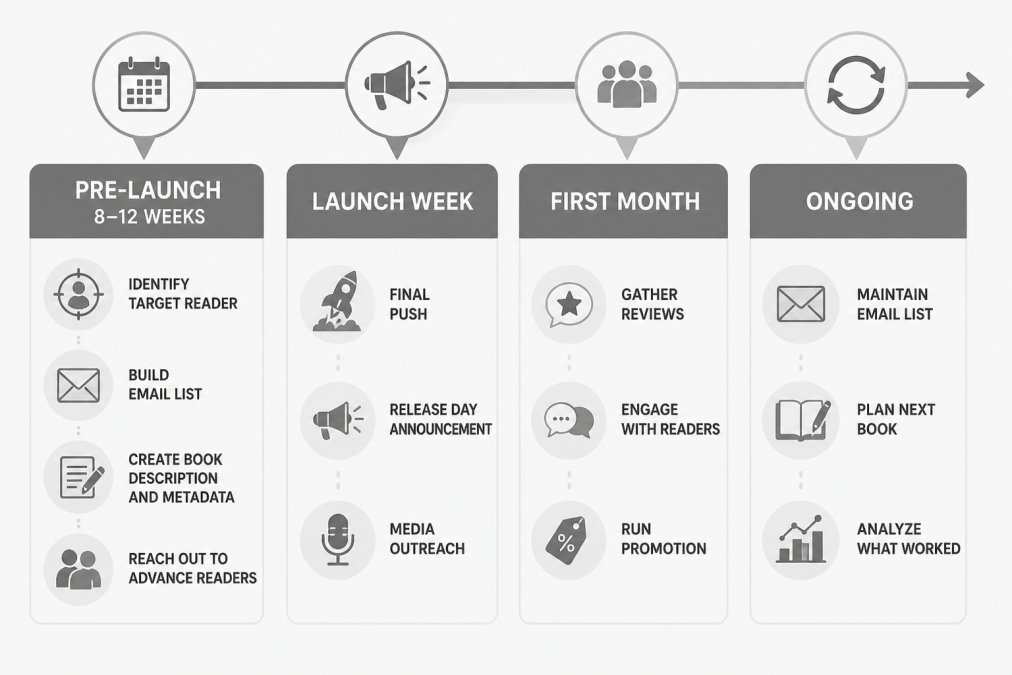
Pre-launch phase (8-12 weeks before)
Start here: identify your target reader and refine your book's positioning. Who will love this book? What problem does it solve? What makes it different from similar books?
Eight to twelve weeks before launch, build anticipation. This is the time to build your advance reader list and secure early reviews.
Create your book description and metadata during this phase too. Your book description is marketing copy that appears on retailer pages. Make it compelling.
Launch week and first month
Launch week is your moment of maximum visibility. Make it count. Send an announcement to your email list. Post on social media. Reach out to book bloggers and podcasters who cover your genre.
The first month after launch is critical. Readers who purchase early leave reviews. Those reviews build credibility and help other readers discover your book. Engage with anyone who reviews or mentions your work. Thank them. Build relationships.
Post-launch and ongoing promotion
Marketing doesn't end on launch day. Books that sustain sales are those with ongoing promotion. This is where many authors stumble. They exhaust themselves during launch and then disappear.
Post-launch promotion looks different. You're not chasing the initial spike. You're building steady, sustainable visibility. This means consistent email communication with your list, regular social media presence, and ongoing outreach to reader communities. Consider seasonal promotions or bundle your book with others in your genre.
How to Get More Book Reviews and Reader Engagement
Reviews are the currency of book marketing. They signal credibility to potential readers. They improve your book's visibility on retailer pages. They give readers confidence to buy. Without them, your book is invisible.
Advance reader copies and book club outreach
Advance reader copies (ARCs) are your secret weapon. Send them to readers, book clubs, and book bloggers before your official launch. They have time to read and review before release day. Those early reviews create momentum.
Book clubs are goldmines for reader engagement. A single book club selection reaches 10, 20, sometimes 50 readers at once. Those readers discuss your book, recommend it to others, and often leave reviews.
Encouraging reviews from readers
Don't assume readers will leave reviews on their own. Most won't. You have to ask. After someone purchases your book, send them a follow-up email thanking them and asking for a review. Make it easy by providing direct links to review platforms.
Some authors offer incentives for reviews, like entry into a giveaway. Be transparent about this. Readers appreciate authenticity. A simple, genuine request often works better than elaborate incentive schemes.
Author Marketing Plan Examples by Genre and Goal
Different genres require different approaches. A romance author's strategy looks different from a business author's. Your goals matter too. Are you building a sustainable writing career or testing the market with a single book?
Fiction authors building a fan community
Fiction readers want connection. They want to feel part of a community around the books they love. Build this by being accessible and engaged. Share your writing process. Ask readers what they'd like to see in future books.
For fiction, book clubs and reader communities are especially powerful. These groups are where passionate readers gather. A strong book club feature can sell hundreds of copies and create readers who follow your career long-term.
Non-fiction authors establishing authority
Non-fiction readers are often seeking expertise and solutions. Position yourself as a knowledgeable guide in your field. Share insights on social media. Write guest posts for industry publications. Appear on podcasts.
For non-fiction, media outreach and speaking opportunities matter more. Podcast interviews reach engaged audiences interested in your topic. Media mentions position you as an expert. These activities have longer-term value beyond a single book sale.
Book Marketing Plan Template and Action Steps
A marketing plan doesn't need to be complicated. It needs to be clear and actionable. Here's what to include.
Core strategy elements to define
Start by answering these questions:
- Who is your ideal reader? Be specific. Not "everyone who likes books," but "women aged 30-50 who enjoy emotional fiction" or "entrepreneurs interested in productivity systems."
- What is your positioning? How is your book different? What makes it worth reading over similar books?
- What are your goals? Sales numbers? Building an email list? Establishing authority?
- What platforms will you use? Where do your readers spend time?
- What's your budget? Time and money both matter. Be realistic about what you can invest.
Monthly action checklist
Each month, focus on these core activities:
- Send at least two emails to your list with valuable content or updates
- Post consistently on your chosen social media platform (3-5 times per week)
- Reach out to 10-20 book clubs or reader communities relevant to your book
- Engage with readers who mention or review your work
- Track sales and reviews to see what's working
- Adjust your strategy based on what you learn
| Activity | Frequency | Time Investment | Expected Outcome |
|---|---|---|---|
| Email to subscriber list | 2x per month | 2-3 hours | Maintain reader connection, drive sales |
| Social media posts | 3-5x per week | 5-8 hours | Build audience, share expertise |
| Book club outreach | 10-20 per month | 4-6 hours | Secure selections, generate reviews |
| Reader engagement | Daily | 1-2 hours | Build community, encourage word-of-mouth |
| Analytics review | 1x per month | 1 hour | Identify what works, refine strategy |
Marketing Your Book Without Breaking the Bank
Budget constraints are real for most self-published authors. The good news: effective marketing doesn't require massive spending. It requires strategy and consistency.
Free and low-cost tactics work surprisingly well. Building an email list costs nothing. Social media presence costs nothing.
Paid advertising can amplify results, but only after you've built a foundation. Start with organic reach. Learn what resonates with your audience.
Many authors find success with targeted, modest spending on book advertising platforms.
Measuring What Works and Adjusting Your Strategy
Marketing without measurement is guesswork. You need to know which activities drive results so you can invest your time and energy wisely.
Track these metrics:
- Sales: How many copies did you sell each month? When did sales spike and why?
- Email list growth: How many new subscribers did you add? What incentive brought them in?
- Social media engagement: Which posts got the most interaction? What topics resonate?
- Reviews: How many reviews did you receive? Which outreach efforts led to reviews?
- Website traffic: Where do visitors come from? What pages do they spend time on?
Review these numbers monthly. Look for patterns. If one outreach approach generates reviews consistently, do more of it.
Your first marketing plan won't be perfect. That's fine.
Book marketing doesn't have to be overwhelming or expensive. It requires a clear plan, consistent action, and willingness to adjust based on results.
Frequently Asked Questions
What should a marketing plan for a self-published book include?
A solid marketing plan covers your target audience, book positioning, launch timeline, promotion channels (email, social media, book clubs), review strategy, and how you'll measure success. Define your ideal reader, choose 2-3 channels where they spend time, set realistic goals for the first 90 days, and plan for ongoing promotion beyond launch. The best plans are specific to your genre and tied to actual reader communities, not just generic tactics.
How far in advance should an author start marketing a book?
Begin your marketing plan 8-12 weeks before launch. In the first 4-6 weeks, build your email list, set up your author website, and reach out to book clubs and advance readers. Use weeks 6-8 for review copies and media outreach. The final 4 weeks focus on launch momentum, paid ads, social media pushes, and retailer visibility. Starting this early gives you time to build genuine reader interest instead of rushing last-minute promotion.
How can authors get more reviews for their books?
Send advance reader copies (ARCs) to book clubs, book bloggers, and engaged readers in your genre 4-6 weeks before launch. Ask directly but respectfully for reviews. Connect with book club communities where readers naturally discuss and review books together. Consider reaching out to genre-specific podcasts and reading circles. Reviews from real reader communities carry more weight than random reviews and often lead to word-of-mouth momentum.
What are the most effective ways to promote a self-published book?
The most effective strategies focus on reaching actual readers where they gather: book clubs, reading circles, genre-specific communities, and podcasts. Combine this with an email list you build before launch, social media content that attracts your ideal reader, and a professional author website. Paid ads on Amazon or social platforms work best when targeting specific reader interests. The key is consistency, pick 2-3 channels and commit to them rather than trying everything at once.
How often should self-published authors promote their books?
Promotion isn't a one-time event. Plan for consistent activity: weekly social media posts or email updates, monthly review outreach or book club pitches, and seasonal pushes around holidays or relevant events. After the first 90 days of intense launch activity, shift to sustainable long-term promotion, this might mean 5-10 hours per week on marketing tasks. The goal is staying visible to readers without burning out.
How do self-published authors find readers for their books?
Start by identifying where your ideal readers already gather: book clubs, reading circles, genre-specific forums, podcasts, and local bookstores. Build an email list from day one, this becomes your most valuable reader asset. Connect on social media platforms where your genre thrives. Reach out to book bloggers and reviewers in your niche. Consider working with communities and platforms designed to match authors with engaged readers in their specific genre.
What is the 90/10 rule for authors?
The 90/10 rule suggests that 90% of your content and interaction should provide value to readers (stories, insights, entertainment, helpful information), while only 10% should directly promote your book. This builds trust and keeps your audience engaged rather than feeling sold to constantly. Apply this across email, social media, and author platforms, share behind-the-scenes writing insights, reader recommendations, writing tips, and community engagement far more often than you ask people to buy your book.
What should an author include in a book launch plan?
Your launch plan should cover: pre-launch activities (ARCs, email list building, media outreach), launch-week tactics (social media blitz, email announcements, retailer visibility), and first-month follow-up (reviews, interviews, book club pitches). Include specific dates, channels, and goals. Assign tasks by week. Plan for 2-3 launch activities per day during launch week. A solid launch plan turns your book's release into a momentum event rather than a quiet publication.